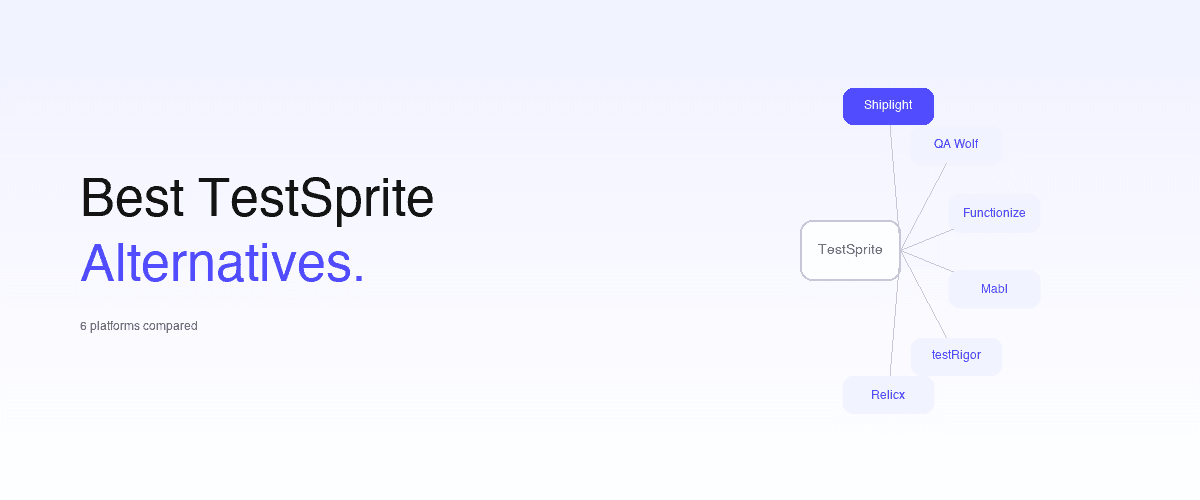
The best TestSprite alternative in 2026 depends on the mechanism you need.
Shiplight AI is the agent-native platform that actually runs where you work: coding agents author tests over MCP, the tests are plain YAML in your git repo, the runtime is built on Playwright, and local runs need no account. Playwright and Cypress are the open-source code frameworks with maximum developer control.
Managed QA services put a vendor's human engineers in charge of your suite. Vendor cloud consoles move authoring into a low-code or plain-English web app, with tests living in the vendor's cloud rather than your repo.
Why teams look for TestSprite alternatives
TestSprite sells spec-driven test generation to the same Claude Code and Cursor audience Shiplight serves: you connect its MCP server, and its agent turns your specs and code into a test plan. What it deposits locally is a spec file plus Python Playwright test files; what actually executes them is TestSprite's hosted runner.
Every run is a cloud run: the CLI rejects localhost and private-IP targets before making any network call, so testing a local app requires routing it through TestSprite's tunnel.
There is no documented way to run the deposited files standalone and no documented export path, and pricing is credit-metered, with what a credit buys undefined on the pricing page itself.
Teams evaluating alternatives usually share one of a few specific frictions: they want tests that run on their own machine, in CI they control; they want the test suite to live in their git repo as portable files rather than as artifacts of a hosted runner; or they want run economics they can predict rather than meter.
The right TestSprite alternative depends on why you're looking. Want local-first execution with tests owned in git? Want maximum developer control on an open-source framework? Want to outsource QA entirely? Different approaches fit different constraints. We build Shiplight, so it's listed first, and we describe every option by its design center.
1. Shiplight AI: best for AI coding agent teams using MCP
Shiplight AI is an agent-native end-to-end testing platform that courts the same Claude Code and Cursor workflow as TestSprite, on the opposite execution model: it runs where you actually work. Your agent points a real browser at localhost like any other URL, generates the test, and runs it on your machine with npx shiplight test, free, before any signup.
Tests are natural-language user intent in plain YAML, committed alongside source in git and reviewed in the same pull request as the feature change.
The Shiplight MCP Server and Skills install into the coding agent itself with a one-line install for Claude Code, Cursor, Codex, VS Code, and more. That is the wedge against TestSprite, whose CLI rejects localhost and private-IP targets by design, so every run is a cloud run.
Shiplight is built on Playwright, so it supports every Playwright browser and runs alongside existing Playwright suites. Cached locators committed to the repo heal at run time; larger changes arrive as reviewable PR diffs, not silent rewrites.
Strengths
- Runs where you work, truly locally. Your agent tests the app you are already running against
localhost, free and with no account. TestSprite's CLI hard-rejects localhost and private IPs before any network call, so a local build is reachable only by exposing it to their cloud runner. - A test suite you own and can run standalone. Tests are real, runnable YAML in your
gitrepo: reviewable in PRs, diffable, portable, and they keep running if you leave. TestSprite deposits generated files locally, but they are artifacts of its hosted runner with no documented standalone-run or export path. - Genuinely agent-native via MCP and Skills. The coding agent that wrote the feature also authors, runs, and heals its test in the same session, and the suite is yours. TestSprite's MCP wraps its hosted runner, so its own agent does the work in the cloud and your agent is a client. See MCP for testing.
- Local runs with no account, predictable cost. Authoring and execution work on your machine before any signup; cloud runners are there when you want hosted CI scale. TestSprite is credit-metered, and because every run is a cloud run, every run spends credits, with what a credit buys undefined on its pricing page.
- Built on Playwright, no lock-in. The YAML transpiles to Playwright, runs alongside an existing suite, and ejects anytime. TestSprite's generated files stay tied to the hosted runner.
- Intent-based self-healing as default: tests survive UI refactors that break selector-bound frameworks. See intent, cache, heal pattern.
- PR-time CI gates on GitHub Actions, GitLab CI, and CircleCI.
- Enterprise posture: SOC 2, VPC/private cloud, hosted CI runners, RBAC, dedicated CSM.
Tradeoffs
- Web only: no native mobile or desktop testing.
- Assumes a repo workflow with an engineer or coding agent in the loop; teams authoring in a pure visual builder are the design center vendor consoles serve.
- Platform pricing requires contacting sales (local runs need no account).
Where it fits. Engineering teams using AI coding agents who want tests authored at agent speed, committed in git, runnable locally against the dev server, and gating every pull request. See agent-first testing and the Shiplight adoption guide.
Compare in depth: Shiplight vs TestSprite.
2. Playwright: best for maximum developer control at lowest cost
Self-hosted Playwright is the most popular open-source browser automation framework: code-based, cross-browser (Chromium, Firefox, WebKit), and it runs anywhere Node.js runs, including against localhost with zero ceremony.
Strengths
- Free and open source; no per-seat, per-run, or credit cost.
- Local and CI execution you fully control; no vendor cloud in the loop.
- Maximum flexibility: full programmatic control, cross-browser including Safari (WebKit).
Tradeoffs
- Code-based and selector-bound: every UI refactor can break tests; ongoing maintenance is the cost, even when a coding agent writes the code.
- No built-in self-healing or natural-language authoring.
- Requires engineering effort to build and maintain the harness.
Where it fits. Teams that want maximum control and lowest licensing cost, and have the capacity to maintain a selector-bound suite. Shiplight is built on Playwright and runs alongside an existing Playwright suite, so the two are complementary rather than either/or. See best Playwright alternatives for no-code testing.
3. Cypress: best for developer-friendly JS E2E testing
Cypress is a long-standing open-source E2E framework focused on developer experience: fast local runs, excellent debugging, strong ecosystem.
Strengths
- Excellent debugging and time-travel; fast local feedback against your dev server.
- Large community and plugin ecosystem.
- Developer-friendly authoring for JavaScript teams.
Tradeoffs
- Code-based and selector-driven: same maintenance ceiling as Playwright.
- Historically Chromium-focused (cross-browser is improving but not native-parity).
- No AI / natural-language authoring.
Where it fits. JavaScript teams that want developer-friendly browser testing and own the maintenance. See Playwright vs Cypress and best Cypress alternatives.
4. Managed QA services: outsource the suite entirely
A different answer to the generation problem is to stop authoring at all: managed QA services put the vendor's human engineers (assisted by AI tooling) in charge of building and maintaining your test suite, usually with an outcome or coverage agreement.
Strengths
- Fully managed: you don't author or maintain tests yourself.
- Human review on top of AI generation.
- Fast ramp for teams with no QA function.
Tradeoffs
- You are buying human hours, priced accordingly; coverage grows at the pace of the vendor's engineers.
- Testing knowledge accumulates with an external team rather than in your repo and your heads.
- No agent-native loop: the vendor's staff authors tests, not your coding agent, which points the opposite direction from an AI-native development workflow.
Where it fits. Teams that have decided QA is someone else's job and want a staffed service with a human in the loop.
5. Vendor cloud consoles: low-code authoring in the vendor's app
The largest commercial category answers the authoring problem with a console: your QA team builds tests in the vendor's web application, via a recorder, a visual editor, or a constrained plain-English command language, sometimes spanning web, mobile, and API from one platform.
Strengths
- Accessible to non-engineers; no repo workflow required.
- Often broader surface coverage (mobile, API) than web-focused tools.
- Governed, centralized management for QA organizations.
Tradeoffs
- Tests live in the vendor's cloud, not your git repo; export paths are typically limited, lossy, or absent, so migration means re-authoring.
- Runs are metered or quote-priced on vendor infrastructure.
- Agent integrations, where offered, drive the vendor's cloud rather than putting tests in your workflow.
Where it fits. Manual-QA-heavy organizations where non-engineers own testing and a governed console is the point, a genuinely different buyer from the coding-agent workflow TestSprite and Shiplight both target.
Quick comparison table
| Alternative | Runs locally against localhost? | Suite you own & can run standalone? | Whose agent does the work? | Run economics | Best for |
|---|---|---|---|---|---|
| Shiplight AI | ✓ Free, no account | ✓ Real YAML in your git repo | Your coding agents via MCP + Skills | Local runs need no account; Free $0, Pro $60/mo | AI-coding-agent teams |
| Playwright | ✓ | ✓ Code in your repo | Your engineers, or agent tooling you assemble | Free, open source | Developer control |
| Cypress | ✓ | ✓ Code in your repo | Your engineers | Free, open source (paid cloud parallelization) | JS team E2E |
| Managed QA services | ✗ Their infrastructure | Varies; knowledge lives with their team | The vendor's human engineers | Human hours | Fully outsourced QA |
| Vendor cloud consoles | ✗ Their cloud | ✗ Proprietary format, limited or no export | The vendor's console tooling | Metered / quote-priced | Console-authoring QA orgs |
| TestSprite (baseline) | ✗ Cloud-only; CLI rejects localhost | File deposit; no documented standalone-run or export | MCP wraps its hosted runner | Credit-metered; per-credit cost undefined | Cloud-run spec-driven generation |
How to choose between TestSprite alternatives
Match the alternative to your dominant constraint:
- Your coding agent should author tests that live in your repo and run on your machine → Shiplight. TestSprite also ships MCP and deposits files locally; the mechanism difference is that Shiplight's execution is local-first (free, no account, localhost included) on a runtime built on Playwright, while TestSprite's MCP wraps a hosted runner: execution is cloud-only, the CLI rejects localhost targets, and there is no documented standalone-run or export path. See boost test coverage with agentic AI.
- You want maximum developer control at lowest cost → Playwright or Cypress: open-source code, fully self-hosted, no vendor in the loop.
- You want to outsource QA entirely, with human oversight → a managed QA service; an outside team owns the operation.
- A vendor console with visual or English-style authoring is acceptable → that category exists, with the repo and export trade-offs above.
For the broader landscape, see best AI testing tools in 2026 and best agentic QA tools in 2026.
Conclusion: pick the alternative that matches your dominant constraint
There is no single "best" TestSprite alternative; each approach is built around a different mechanism. If your coding agent should author tests that live in your repo and run free on your machine, evaluate Shiplight first. Playwright and Cypress give maximum developer control on open-source code.
Managed services exist for teams outsourcing QA entirely. Vendor consoles serve QA organizations authoring outside the repo.
If you have narrowed the decision to two tools, the Shiplight vs TestSprite breakdown goes deeper on that specific comparison.
Some teams want spec-to-test generation and tests owned in git and local-first execution, which is the combination TestSprite's cloud-only model does not offer. Shiplight AI is built for exactly that.
Tests are intent-based YAML committed in git; MCP plus Skills are callable from Claude Code, Cursor and Codex; runs work locally with no account; self-healing is on by default, with larger changes proposed as reviewable PR diffs; and CI gates run at PR time.
Book a 30-minute walkthrough and we'll compare your current TestSprite setup to a Shiplight migration path tailored to your stack.
Frequently Asked Questions
What is TestSprite?
A spec-driven test generation tool for Claude Code and Cursor. Its MCP server writes a spec plus Python Playwright files locally, but execution happens on TestSprite's hosted runner and the CLI rejects localhost. Pricing is credit-metered, with what a credit buys undefined.
What is the difference between TestSprite and Shiplight?
Both integrate over MCP; the execution model differs. TestSprite runs the suite on its hosted runner, with no documented export path and a CLI that rejects localhost. Shiplight is local-first: your agent authors YAML in your repo with no Shiplight account, and runs it wherever you like, localhost included. See Shiplight vs TestSprite.
Why look for a TestSprite alternative?
Four reasons: execution is cloud-only, so a local dev server needs their tunnel; the deposited files have no documented export path; credits are metered without the page defining what one buys; and the MCP integration wraps the hosted runner rather than letting your agent run tests locally.
What is the best free or open-source TestSprite alternative?
Playwright and Cypress are the open-source baselines: full control, local execution, no lock-in, if you are happy owning selector-bound code. For AI-driven testing with tests in your repo, Shiplight's local MCP and npx shiplight test need no account. See the Shiplight adoption guide.
Which TestSprite alternative is best for AI coding agents like Claude Code or Cursor?
Shiplight. One-line install into Claude Code, Cursor, or Codex as MCP plus Skills; the agent generates the feature and its test, runs it locally, and commits both in one pull request. TestSprite courts the same audience, but its MCP wraps a hosted runner. See MCP for testing.
Which TestSprite alternative is best for enterprise?
Depends who authors tests and where they live. If engineering owns testing, Shiplight is SOC 2 certified with VPC deployment, RBAC, and tests in your repo where heals are reviewed as PR diffs. If a QA organization authors in a governed console, the vendor-cloud category serves that. See self-healing tools for enterprises.
Can I migrate from TestSprite to another tool?
There is no documented export path, so every migration re-authors. Moving to Shiplight is incremental: new flows in YAML in your repo, old coverage retired as features change. Playwright means writing the suite in code; console platforms mean starting fresh in their tool.
Is TestSprite production-ready?
It is a hosted, credit-metered platform. For regulated environments, evaluate it against your own compliance requirements. Otherwise the usual questions apply: CI integration, trustworthy signal, acceptable failure mode. Cloud-only execution is a structural constraint if you test local builds. See the agentic QA benchmark.