A software testing strategy is the operating model that defines what your team tests, how it is authored, when it runs, and who is accountable for it.
The newest viable pattern, and the one Shiplight implements, is the agentic strategy: your coding agent authors and maintains the tests, and they live in your repository. "Strategy" is the layer above any specific test or test plan: it is the framework that makes the tests valuable in the first place.
Most teams in 2026 do not use one strategy; they combine three or four from a menu of about twelve well-established approaches: risk-based, requirements-based, model-based, exploratory, agile, BDD, TDD, ATDD, pair, crowdsourced, AI-augmented, and agentic.
This guide surveys all twelve with concrete examples and explains how to choose, combine, and evolve them, including how the AI coding era has added the agentic strategy as the newest viable pattern.
Key takeaways
For the opinionated AI-native-only framework, pair this guide with AI-native test strategy in 2026.
- Strategy is the operating model, not a list of test cases. A test plan tells you which tests run next; a strategy tells you why those tests, why that authorship model, why that gate latency.
- There are 12 major software testing strategies in active use in 2026. Most teams combine 3–4 of them.
- The right mix depends on context: regulated industry, AI-coding-agent adoption, team size, release cadence, and risk profile each shift which strategies fit.
- The agentic strategy is the newest mainstream pattern (added since 2024) and is the largest strategic shift since agile testing in the early 2000s.
- Strategy ≠ plan. Strategy is quarterly / annual and defines the framework. Plan is release-level and lists the specific tests.
What is a software testing strategy?
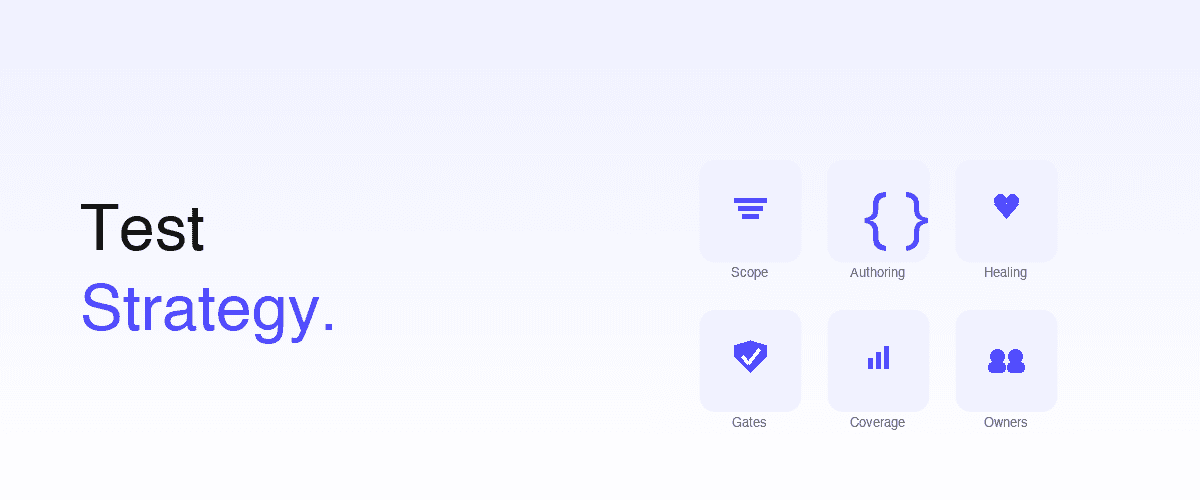
A software testing strategy is a high-level operating model that answers six questions for a software product or team:
- What gets tested? (Scope: layers, surfaces, environments.)
- How are tests authored? (Code, no-code, intent-based, AI-generated.)
- When do tests run? (Pre-commit, PR-time, nightly, release gate.)
- What happens when tests fail or break? (Manual repair, self-healing, agent-fixed.)
- How is coverage measured? (Test count, journey reach, decay rate.)
- Who is accountable? (Engineer, agent, QA team, oversight.)
A strategy is not the list of specific test cases: that's the test plan. The strategy provides the framework that determines which test cases are valuable in the first place. See the strategy vs plan section for the full distinction.
For the foundational testing terms underlying every strategy, see what is software testing. For the opinionated 2026-AI-native version, see AI-native test strategy in 2026.
Strategy vs plan: the canonical distinction
These two terms get used interchangeably and that's incorrect:
| Dimension | Test Strategy | Test Plan |
|---|---|---|
| Scope | Team / product line / org | Specific release or feature |
| Lifespan | Quarterly to annual | Days to weeks |
| Answers | How do we produce quality? | What are we testing this release? |
| Owned by | QA leadership / engineering leadership | Release engineer / PM |
| Output | Operating model, gates, metrics | Test case list, schedule, exit criteria |
| Reviewed when | Operating model shifts | Every release |
A team without a strategy ends up with tactics no one can defend. A team without a plan ends up with strategy that never produces a release. Most healthy teams have both, with the strategy reviewed quarterly and the plan iterated each sprint.
The 12 major software testing strategies in 2026
Each strategy has a defining question, a target context, and a usage pattern. None are mutually exclusive: most teams combine three or four.
1. Risk-based testing
Defining question: Where is the cost of a defect highest, and where do defects most likely cluster?
Risk-based testing concentrates effort on the parts of the system where failures hurt the most (revenue-blocking flows, regulated logic, high-traffic features) or where defects historically cluster (recently-refactored modules, complex business rules). A risk matrix scores each area on probability × impact; the highest-scoring areas get the densest test coverage.
When it fits: Always: risk-based prioritization is the foundation under every other strategy. Especially useful when test budget is constrained.
Pitfall: Risk scoring done once and never updated. Risk profiles shift as features ship; the matrix must be re-scored quarterly.
2. Requirements-based testing
Defining question: Does the system do what the requirements say it should do?
Each functional requirement gets at least one test that validates it. Traceability matrices link requirements to tests so coverage gaps are visible. Common in regulated industries (healthcare, finance, defense) where auditors will ask to see the link from a regulation to a test.
When it fits: Regulated domains, contract-driven engagements, products with formal specifications.
Pitfall: Tests confirm requirements but miss usability and integration gaps the requirements didn't anticipate.
3. Model-based testing
Defining question: Can the application's behavior be modeled as a graph, and can tests be generated from the model?
A formal model of the application (state machine, decision graph, or workflow diagram) drives test generation. The model can be authored manually or learned from real user behavior. Tools generate test cases that traverse the model's paths, including edge cases a human wouldn't think to write.
When it fits: Complex state machines (e.g., subscription billing, multi-step workflows), products with high combinatorial complexity, teams with model-design expertise.
Pitfall: Models go stale faster than tests. A model not updated alongside product changes generates tests for behavior that no longer exists.
4. Exploratory testing
Defining question: What does the application do when a curious human pokes at it without a script?
A human tester actively explores the application (trying unexpected inputs, racing actions, abandoning workflows halfway, navigating in non-canonical orders), looking for the bug class no scripted test would think to find. Exploratory testing is iterative: each session generates new questions that drive the next session.
When it fits: Every team. Especially after a feature release, after a major refactor, or before a high-stakes deploy. Exploratory testing is more important in 2026 because AI handles the regression floor, freeing humans to spend more time exploring. See the QA role in the AI era.
Pitfall: Treating exploratory as "manual regression with no script"; it isn't. Real exploratory testing produces new tests, not repeated existing ones.
5. Agile (shift-left, continuous) testing
Defining question: Can testing happen continuously alongside development rather than as a separate phase?
Testing is embedded in the development cycle: every commit triggers tests, every PR has a CI gate, every sprint has explicit quality goals. The "shift left" principle moves testing earlier (toward design and code review) instead of treating it as a release gate at the end.
When it fits: Any team running iterative development. Effectively the default in 2026.
Pitfall: Sprint-bound testing that still leaves regression work for "later": defeats the strategy by treating shift-left as a slogan rather than a discipline.
For teams thinking about the broader operating model, Fora Soft's guide to QA across every stage of product development is a useful reference for structuring quality checks from planning through release, instead of treating testing as a final pre-launch activity.
6. Behavior-driven development (BDD)
Defining question: Can tests be written in a language stakeholders, not just engineers, can read?
Tests are authored as Given/When/Then statements in Gherkin syntax, executed by frameworks like Cucumber. The test becomes a living specification: a PM can read it, a customer can confirm it, an engineer can run it. BDD bridges the gap between requirements documents and executable verification.
When it fits: Teams with non-engineer stakeholders who own quality decisions (PMs, customers, compliance). Useful for acceptance testing.
Pitfall: Gherkin tests get over-engineered into a parallel programming language. When that happens, the stakeholder-readability claim collapses and the team has two test stacks for the price of one.
7. Test-driven development (TDD)
Defining question: Can tests be written before the code they verify?
The engineer writes a failing test that describes the desired behavior, then writes the minimum production code to make the test pass, then refactors. The cycle is "red, green, refactor." TDD produces high unit-test coverage as a byproduct and forces engineers to think about behavior before implementation.
When it fits: Unit testing for new code in well-understood domains. Pairs well with intent-based system-level testing.
Pitfall: TDD scales poorly to ambiguous or research-style work where you don't yet know what the right behavior should be. Forcing TDD in those contexts produces brittle tests for incorrect specifications.
8. Acceptance test-driven development (ATDD)
Defining question: Can the acceptance criteria themselves be written as executable tests, agreed before development starts?
Customer, PM, and engineer agree on acceptance tests before the feature is built. The tests become the source of truth for "done." ATDD is BDD applied at the acceptance level, with the criteria locked in advance.
When it fits: Customer-facing development with explicit acceptance criteria. Common in enterprise vendor engagements.
Pitfall: Acceptance tests authored too narrowly: they confirm the literal acceptance criteria but miss the surrounding usability and edge cases. Pair ATDD with exploratory testing.
9. Pair testing
Defining question: Can two people testing together find bugs that one person testing alone would miss?
Two people sit together (or share a screen): one drives the test, the other observes and questions. The observer catches assumptions the driver doesn't realize they are making. Effective for exploratory work, for onboarding new team members, and for high-stakes pre-release verification.
When it fits: Pre-launch testing of critical features, onboarding new QA engineers, cross-team verification.
Pitfall: Treated as continuous practice rather than a focused tool: pair testing is high-investment per session, best used selectively.
10. Crowdsourced testing
Defining question: Can a large, distributed pool of testers run an application across more environments and inputs than an in-house team can?
A managed third-party network (or your own user community) tests the application across devices, locales, accessibility profiles, and edge cases the in-house team can't replicate. Best for breadth of coverage (many environments, many user perspectives) rather than depth.
When it fits: Consumer-facing products before launch, accessibility certification, multi-locale validation.
Pitfall: Quality of crowdsourced bug reports varies wildly. Triage cost can offset the testing benefit if not managed actively.
11. AI-augmented testing strategy
Defining question: Where does AI augment a fundamentally script-based or human-driven testing operation? The category has a name and a boundary: AI-augmented testing.
AI features (smart locators, flakiness detection, visual diff scoring, assisted authoring, anomaly clustering on failures) are layered onto traditional automation. The operating model remains human-led; AI removes friction at specific steps. See AI in test automation.
When it fits: Teams modernizing an existing Playwright / Cypress / Selenium suite who want incremental gains without a full operating-model change.
Pitfall: Mistaking AI augmentation for AI strategy. Augmentation reduces friction; it doesn't change the underlying selector-binding ceiling.
12. Agentic testing strategy
Defining question: Can AI agents own the test authoring, exploration, execution, and healing loop, with humans in oversight?
The newest mainstream strategy. AI agents author tests from intent or specs, autonomously explore the application to discover untested flows, run tests in real browsers, self-heal across UI change, and feed results back into the coding loop. The human role moves to oversight, policy, and judgment. See what is agentic QA testing and agent-native autonomous QA.
When it fits: Teams using AI coding agents (Claude Code, Cursor, Codex) at scale, teams that have hit the 100–200-test-per-engineer maintenance ceiling under traditional automation, teams adopting intent-based testing.
Pitfall: Adopting "agentic" labels without the underlying mechanics: true agentic strategy requires self-healing as default, MCP-style agent integration, PR-time gates, and the policy framework to govern the agent's decisions.
How to choose a software testing strategy
- Step 1Identify your dominant risk profile
- Step 2Match strategy to lifecycle stage
- Step 3Document the combination as your strategy
Three steps:
Step 1: Identify your dominant risk profile
| If your highest risk is... | Anchor strategies |
|---|---|
| Revenue / payments flows | Risk-based + exploratory + agentic |
| Regulated logic (HIPAA, PCI, SOX) | Requirements-based + ATDD + risk-based |
| Rapid UI iteration | Agentic + exploratory + agile |
| Complex business workflows | Model-based + BDD + risk-based |
| Accessibility / locale breadth | Crowdsourced + requirements-based |
| Existing legacy automation | AI-augmented + risk-based |
| Greenfield product | Agile + TDD + agentic |
The anchor strategies are starting points; layer additional ones as the product matures.
Step 2: Match strategy to lifecycle stage
- Pre-release: Exploratory + pair testing (catch what scripts miss)
- Per-PR: Agentic + AI-augmented (fast, focused gates)
- Per-sprint: Agile + BDD (continuous quality)
- Pre-launch: Crowdsourced + risk-based + exploratory (breadth + depth)
- Production: Risk-based monitoring + anomaly detection (continuous, ambient)
Step 3: Document the combination as your strategy
Write down which strategies apply to which scopes, who owns each, and how they are measured. This is the "test strategy document." See the strategy template in the AI-native test strategy guide for a copy-able example.
Established frameworks that systematize strategy
Two well-known frameworks worth knowing:
Heuristic Test Strategy Model (HTSM)
James Bach's framework that organizes strategy around four dimensions: Project Environment (people, equipment, schedule), Product Elements (structure, function, data, platform), Quality Criteria (capability, reliability, usability, security, performance), and Test Techniques (function testing, domain testing, stress testing, etc.). Useful as a checklist when building or auditing a strategy.
ISO/IEC/IEEE 29119
The international standard set for software testing. Defines processes, documentation templates, and quality criteria. Adopted by regulated industries and large enterprises for compliance and audit purposes. More structured than HTSM, less flexible: best when external audit requirements drive the documentation discipline.
Most 2026 teams pull from these frameworks selectively rather than adopting them wholesale. The frameworks are catalogs of moves, not playbooks for any particular team.
How modern strategies are evolving in 2026
The 12 strategies above are stable; their combination and implementation are evolving rapidly. Three shifts to know:
- Agentic strategy moves from edge to mainstream. What was an experimental approach in 2024 is the operating default for AI-coding-agent teams in 2026. See agent-first testing.
- Strategy review cadence accelerated. Annual strategy reviews (2015 norm) became quarterly (2020 norm) and are now monthly or trigger-driven for fast-moving teams. The trigger: any KPI breach (e.g., maintenance budget above 5%), tool change, or coding-agent adoption shift.
- Coverage measurement matured. Raw test count gave way to user-journey reach + coverage-decay rate + maintenance budget + PR-time verification density as the canonical four-metric stack. See the agentic QA benchmark.
For the full 2026 modernization narrative, see software testing basics in 2026 and AI-native test strategy in 2026.
Common strategy pitfalls
- One-strategy thinking. "We do agile testing" or "we do risk-based testing": strategies are not exclusive. Real teams combine 3–4.
- Strategy lock-in. A strategy that worked in 2020 may not fit 2026's coding-agent throughput. Quarterly review prevents drift.
- Strategy without metrics. A strategy that doesn't define how to measure success is a slogan, not a strategy.
- Strategy without owner. A strategy with no named owner gets revised by Slack consensus and gradually loses coherence.
- Tooling first, strategy after. Picking a tool and reverse-engineering a strategy around its features locks the team into the tool's assumptions. Strategy first; tool second.
Tools and the 12 strategies
The honest mapping of which tools implement which strategies well:
| Strategy | Representative tools |
|---|---|
| Risk-based | Most test-management platforms (TestFiesta, Xray, TestRail) |
| Requirements-based | DOORS, Jama, requirements-traceability features in TestRail |
| Model-based | GraphWalker, ConformIQ |
| Exploratory | Manual; session-based test management tools |
| Agile / shift-left | Any CI/CD platform; pre-commit hooks; PR-time gates |
| BDD | Cucumber, SpecFlow, Behat |
| TDD | Unit test frameworks: Jest, JUnit, pytest |
| ATDD | Concordion, Robot Framework, FitNesse |
| Pair testing | No tooling required |
| Crowdsourced | Applause, Testlio, Bugcrowd |
| AI-augmented | Applitools (visual layer); low-code vendor consoles with AI features |
| Agentic | Shiplight (YAML + AI Fixer + MCP) |
| Managed QA service | QA Wolf (vendor QA engineers write and maintain the suite) |
See best AI testing tools in 2026, best agentic QA tools in 2026, and best AI automation tools for software testing for deeper landscape coverage.
Conclusion: strategy is the layer above tactics
Twelve named strategies have stood the test of multiple decades. Most have not changed in their fundamentals since the 2010s: what changes is which combinations make sense for which contexts, and how the implementation evolves with the tooling layer.
The 2026 inflection is the rise of the agentic strategy from edge case to mainstream default for AI-coding-agent teams. Most teams combine 3–4 strategies; almost none use exactly one.
For teams ready to operationalize an agentic strategy alongside their existing mix, Shiplight AI implements the building blocks: YAML Test Format for intent-based authoring, AI Fixer for self-healing as default, MCP Server for agent-native verification, and Cloud runners for PR-time gates.
Book a 30-minute walkthrough and we'll map your current strategy mix to the 12-pattern menu above and identify the additions worth making first.
Frequently Asked Questions
What is a software testing strategy?
A software testing strategy is the high-level operating model that defines what your team tests, how it is authored, when it runs, who owns it, and how coverage is measured. It is distinct from a test plan, which is a release-specific list of test cases and schedule.
What are the major types of software testing strategies?
Twelve are mainstream: risk-based, requirements-based, model-based, exploratory, agile or shift-left, BDD, TDD, ATDD, pair testing, crowdsourced, AI-augmented, and agentic. Most teams combine three or four depending on context.
How is a testing strategy different from a testing methodology?
A strategy is the operating-model document for one team or product: what we test, how, when, by whom. A methodology is a named, transferable approach like TDD or BDD. Methodologies are the building blocks; the strategy is the assembled house.
What is risk-based testing?
It concentrates effort where failures hurt most, revenue-blocking, regulated, high-traffic, or where defects historically cluster. A matrix scores each area on probability times impact, and the highest scores get the densest coverage. It is the foundation under most other strategies.
What is the difference between BDD and TDD?
TDD writes a failing unit test, then code to pass it, then refactors. It is engineer-facing and unit-level. BDD writes Given/When/Then so stakeholders read tests as living specifications, usually at acceptance level. They coexist: TDD for unit work, BDD for acceptance.
What is an agentic testing strategy?
AI agents own most of the loop: authoring from intent, exploring for untested flows, running in real browsers, healing across UI change, feeding results back to the coding loop. The human role moves to oversight. See what is agentic QA testing.
How do I choose a testing strategy for my team?
Identify your dominant risk profile: revenue flows, regulated logic, rapid UI iteration, legacy automation, or greenfield. Pick anchor strategies that match, then layer others for lifecycle stages. Document the combination and review it quarterly.
Can a team use multiple testing strategies at once?
Yes, and most do. A common combination is risk-based prioritization, agile lifecycle integration, agentic at the system level, exploratory before release, and BDD for acceptance criteria. The strategy document declares which applies to which scope.