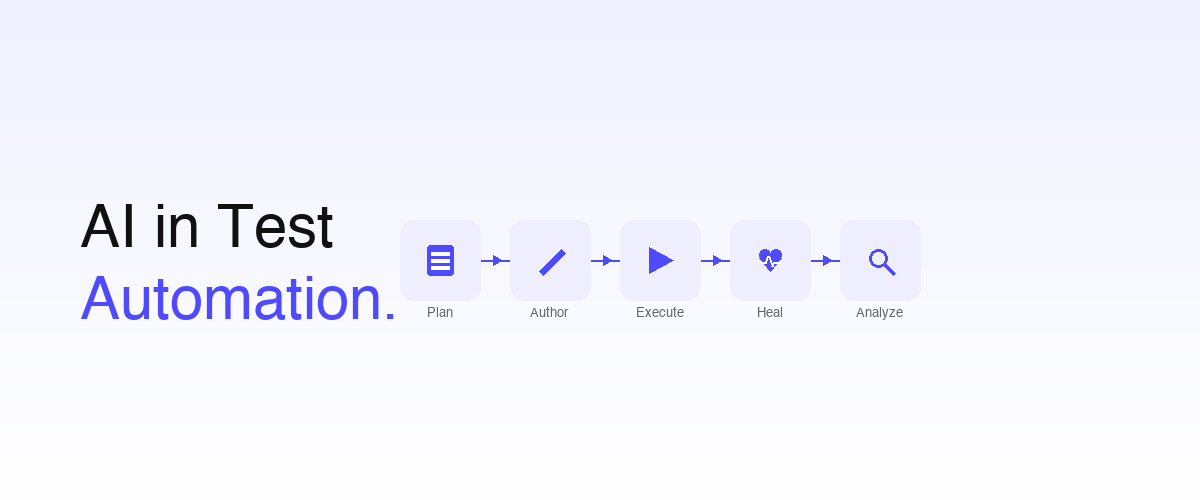
The best AI automation tools for software testing in 2026 depend on which part of the testing loop you want automated.
Shiplight AI automates the whole loop for engineering teams building with AI coding agents: intent-based YAML tests in your git repo, built on Playwright, self-healing by default. Open-source Playwright, Cypress, and Selenium remain the code-first execution foundations.
Applitools and Percy automate visual regression, and BrowserStack automates cross-browser execution. Enterprise codeless suites such as ACCELQ cover packaged-app estates, vendor cloud consoles (testRigor is a representative example) serve manual-QA organizations, and managed services such as QA Wolf outsource the suite entirely.
The right choice depends on who authors your tests and where they live.
What counts as an AI testing automation tool
"AI automation tools" covers a wide category in 2026: from general-purpose workflow automation to specialized software testing platforms. This guide focuses specifically on AI automation tools for software testing: the tools and layers that use automation (AI-driven or not) to generate, execute, heal, and maintain tests with minimal manual effort.
A caution before the list: nearly every vendor in this market now describes itself as "agentic" or "autonomous." The entries below classify tools by how they actually operate, not by their marketing. The tools differ significantly in what they automate: some generate tests from intent, some heal broken tests, some automate only execution or visual comparison.
The right tool depends on your team's workflow and whether you're building with AI coding agents.
We build Shiplight AI, so it is listed first, but we will be honest about where each alternative fits.
Quick Comparison: AI Automation Tools for Software Testing
The axes that matter for choosing an AI automation tool are who authors the tests, where they live, what maintenance costs when the UI changes, and whether your coding agent can drive the tool. Device counts and platform breadth solve different problems and are covered in prose where relevant.
| Tool | Design center | Who authors tests | Where tests live | Maintenance model | Coding-agent integration |
|---|---|---|---|---|---|
| Shiplight AI | Agent-native functional E2E | Your coding agent or your team | YAML in your git repo | Intent-level heals as reviewable PR diffs | MCP + Skills across every major coding agent |
| Playwright | Open-source code framework | Your engineers (or their agents), in code | Your git repo | Manual: selectors are yours to fix | Via agent tooling you assemble |
| Cypress | Open-source code framework | Your engineers, in code | Your git repo | Manual | Via agent tooling you assemble |
| Selenium | Open-source code framework | Your engineers, in code | Your git repo | Manual | Limited |
| Applitools Eyes | Visual-regression layer | n/a (asserts on your existing tests) | Baselines in their cloud | Baseline management | MCP (Playwright JS/TS only) |
| BrowserStack Percy | Visual snapshot review | n/a (snapshots from your suite) | Your repo (renders in their cloud) | Baseline approval workflow | Via BrowserStack MCP |
| BrowserStack Automate | Browser execution infrastructure | n/a (runs your existing suite) | Your repo | n/a | MCP wrapper over the grid |
| testRigor | Vendor-console DSL platform | Your QA team, in their console | testRigor's cloud console | AI re-interpretation on hosted runners | MCP wrapper over the cloud console |
| QA Wolf | Managed QA service | QA Wolf's engineers plus AI | QA Wolf's infrastructure (export is the escape hatch) | Human-backed SLA, not a self-healing runtime | No MCP server for coding agents |
| ACCELQ | Enterprise codeless platform | QA org, codeless in their cloud | ACCELQ's cloud | Self-healing locators | None documented |
| TestWheel | AI no-code, multi-surface (web, mobile, API, performance, security, desktop) | Your QA team, via web console or API | TestWheel's cloud workspace | AI self-healing plus manual updates | None documented |
The 11 Best AI Automation Tools for Software Testing
1. Shiplight AI: AI-Native Automation for Coding Agent Workflows
Best for: Engineering teams building with AI coding agents who want tests generated, executed, and maintained automatically during development.
Shiplight is an agentic QA platform built for the AI-native era. Shiplight exposes browser automation and testing capabilities as Model Context Protocol (MCP) tools that Claude Code, Cursor, Codex, and GitHub Copilot can call directly. Tests are written in intent-based YAML: readable by anyone who can follow a bulleted list and self-healing when the UI changes via the intent-cache-heal pattern.
goal: Verify user can complete checkout
steps:
  - intent: Log in as a test user
  - intent: Add the first product to the cart
  - intent: Proceed to checkout
  - intent: Complete payment with test card
  - VERIFY: order confirmation page shows order number
What Shiplight automates:
- Test generation from specs and from UI changes the coding agent just made
- Test execution in a real Playwright browser (Shiplight's YAML transpiles to Playwright each run, so every Playwright browser is supported)
- Self-healing: re-resolving intent when locators break, with larger heals proposed as PR diffs
- Failure interpretation: structured output agents can act on
Strengths: The only AI automation tool with native MCP integration (MCP plus Skills, major coding agents). Tests live in your git repo, no vendor lock-in.
A full platform, not just a tool: authoring, self-healing, hosted runners, dashboards, reporting, and first-party support, so you are not on your own. Local runs with no account, SOC 2 certified and VPC deployment for enterprise.
Tradeoffs: Web only (no mobile device cloud). Newer platform than the incumbent suites. Not the right pick if an existing Playwright suite already works well with low maintenance.
2. Playwright: The Open-Source Foundation
Best for: Engineering teams that want maximum control and own the maintenance.
Playwright is the most capable open-source browser automation framework: cross-browser (Chromium, Firefox, WebKit), fast, with auto-waiting, its own codegen recorder, and first-party agent tooling. It is also the foundation Shiplight is built on, and the execution engine under much of the commercial category.
What it automates: Execution. Playwright is not an AI tool itself; teams with engineering capacity sometimes assemble custom AI automation around it rather than buying a platform.
Strengths: Free, no vendor, full programmatic control, the largest modern ecosystem.
Tradeoffs: Tests are selector-bound code. Someone fixes them when the UI changes, and that holds whether a human or a coding agent wrote them; there is no built-in self-healing.
For the full head-to-head with Shiplight, see Shiplight vs Playwright.
3. Cypress: Developer-Experience-First E2E
Best for: JavaScript-first teams that value interactive debugging.
Cypress is the developer-experience-focused E2E framework: an in-browser runner with time-travel debugging and a mature JavaScript ecosystem. Parallel execution officially requires the paid Cypress Cloud.
Strengths: Excellent authoring and debugging experience, strong community, free and open source.
Tradeoffs: The same selector-maintenance ceiling as any code framework; historically Chromium-focused; paid cloud for parallelization.
See Playwright vs Cypress for that decision.
4. Selenium: The Polyglot Installed Base
Best for: Organizations with existing Selenium investments and polyglot language requirements.
Selenium is the longest-standing browser automation project, with the broadest language bindings and grid ecosystem. Most new suites start on Playwright or Cypress today, but Selenium remains widely deployed and deeply integrated in enterprise CI.
Strengths: Mature, language-agnostic, huge installed base, free and open source.
Tradeoffs: More boilerplate and flakier defaults than modern frameworks; no AI capabilities.
See best Selenium alternatives if you're evaluating a move.
5. Applitools Eyes: Visual AI as a Layer
Designed for: Visual regression testing and cross-browser UI validation, as a layer over functional E2E.
Applitools is a visual-testing specialist: its Visual AI detects layout shifts, visual bugs, and cross-browser inconsistencies while tolerating rendering noise that pixel-exact comparison would flag. It integrates with Selenium, Cypress, and Playwright as an assertion layer; your tests stay in your repo while baselines and match settings live in Applitools' cloud.
What it automates: Visual comparison and baseline management, not functional testing. You still need a functional E2E tool underneath it.
Pricing: Free trial only; plans are quote-based.
6. BrowserStack Percy: Visual Snapshot Review
Designed for: Teams that want cross-browser visual review integrated into an existing suite.
Percy captures DOM snapshots during your test runs, re-renders them across browsers and viewport widths in its cloud, and diffs against approved baselines with a git-aware review workflow. It adds a visual layer to Playwright, Cypress, or Storybook runs without new test logic.
What it automates: Snapshot capture, cross-browser re-rendering, and diff review. It asserts nothing functional.
Pricing: Free tier (5,000 screenshots/month); paid plans published on BrowserStack's site.
7. BrowserStack Automate: Cross-Browser Execution Infrastructure
Designed for: Teams that need real-device and cross-browser coverage for an existing suite.
BrowserStack Automate runs your existing Playwright, Cypress, or Selenium tests across a cloud grid of browsers, OS versions, and real devices. It is execution infrastructure: it doesn't author, heal, or interpret tests, and it pairs with whatever functional tool produces the suite.
What it automates: Execution coverage only; authoring and maintenance stay yours.
Pricing: Per-parallel pricing, published on their site.
See our BrowserStack alternatives guide if you're comparing grids.
8. testRigor: Constrained-English Cloud Console
Designed for: manual-QA-heavy organizations where non-engineers author tests in a vendor cloud console.
testRigor is a cloud-hosted platform (founded 2015, before the coding-agent era) built to make manual QA productive without engineers, and a representative example of the vendor-console category. Authoring uses a constrained plain-English DSL rather than free English: their own docs note the parsed English "has some syntax to it," and free-form phrasing is LLM-translated into their command set.
Where tests live: as suites in testRigor's cloud console, running on their hosted runners; Selenium export is available only under paid-customer agreements, per the founder's public statements.
Tradeoffs: No repo copy of the tests. Coding-agent access is an MCP server that wraps the cloud console, so it is agent-integrated, not agent-native. Its buyer profile (manual-QA staff authoring without engineers) barely overlaps engineering-led teams wiring tests into a coding agent.
9. QA Wolf: Managed QA Service
Designed for: organizations that have decided to outsource E2E testing entirely rather than build or maintain an internal QA function.
QA Wolf is a managed QA service, not a self-serve tool: its QA engineers, assisted by AI in their tooling, write and maintain standard Playwright/Appium tests that live and run on QA Wolf's infrastructure, and export is the escape hatch rather than the home.
It markets itself as an agentic AI platform; the operating model is people-powered coverage under a human-backed SLA. There is no MCP server for coding agents.
Tradeoffs: New coverage runs through QA Wolf's team, not your workflow. Tests execute on their infrastructure, and testing knowledge accrues outside your own codebase. This is the opposite operating model from owning tests in your repo.
Pricing: Quote-only for the managed service.
10. ACCELQ: Enterprise Codeless Suite
Designed for: enterprises with heterogeneous stacks spanning web, mobile, API, SAP, and desktop, tested by large QA organizations.
ACCELQ is an enterprise codeless platform whose documented strengths are packaged-app coverage (SAP, Salesforce, legacy desktop) and genuine on-prem deployment options for behind-the-firewall requirements. Authoring is codeless in their console; tests are proprietary server entities with no documented export path.
It sits in the enterprise codeless category alongside Tricentis Tosca (the model-based incumbent for SAP-class estates) and Virtuoso QA (constrained natural-language authoring for packaged apps): a different buyer from engineering-led web teams.
Strengths: Broad platform coverage including packaged enterprise apps, real on-prem deployment, codeless authoring for non-programmer testers.
Tradeoffs: Tests live in ACCELQ's proprietary object model, not files in git; no coding-agent surface; enterprise quote-only pricing.
See our ACCELQ alternatives guide for alternatives.
11. TestWheel: AI No-Code Automation Across Web, Mobile, API, and More
Designed for: QA teams that want web, mobile, API, performance, security, and desktop testing on one no-code platform instead of stitching together separate tools per surface.
TestWheel is an AI-powered test automation platform, built by Yakshna Corporation, aimed at QA teams automating across multiple testing surfaces without writing code. Tests are authored through AI natural-language prompts, low-code templates, or a browser recorder, and existing manual test cases or Selenium scripts can be imported and converted into automated tests.
What it automates: Test creation and execution across web, mobile (real devices), API, performance/load, security (via OWASP ZAP), and Windows desktop testing, plus AI-driven self-healing when UI elements change. Execution runs in TestWheel's cloud by default; on-premise requires a custom integration, not a self-serve option.
Strengths: Genuinely broad coverage from one platform, useful for a QA team that would otherwise run separate tools per testing type. No-code authoring lowers the bar for non-engineers.
Tradeoffs: Tests live in TestWheel's cloud workspace, with no documented export path or coding-agent surface. No independent review base was found on G2 or Capterra at the time of writing, despite the parent company being established since 2007.
Pricing: Basic $10/month (1 application, 500 test minutes, 14-day trial); Pro/Team $30/month (up to 5 apps and users, 5,000 test minutes); Enterprise custom.
How to Choose an AI Automation Tool for Software Testing
Team shape matters as much as feature fit: the shortlist for fast-moving teams filters the same field by how quickly you ship.
By your primary automation need
| If you want to automate… | Best fit |
|---|---|
| Verification during AI-assisted coding | Shiplight AI (MCP plus Skills) |
| Test maintenance after UI changes | Shiplight AI (intent-level self-healing in your repo) |
| Visual regression sweeps | Applitools or Percy, as a layer over your functional suite |
| Cross-browser and real-device execution | BrowserStack Automate |
| Packaged enterprise apps (SAP, Salesforce, D365) | The enterprise codeless suites (ACCELQ, Tricentis Tosca, Virtuoso QA) |
| Authoring by manual-QA staff without engineers | A vendor cloud console with structured-English or recorder authoring |
| Outsourcing the QA function entirely | A managed QA service |
| Custom automation on an open-source base | Playwright |
By operating model
| Who authors tests, and where do they live? | Fit |
|---|---|
| Coding agents (Claude Code / Cursor / Codex / GitHub Copilot) author tests in your git repo | Shiplight AI |
| Engineers author code-first tests in the repo and own maintenance | Playwright or Cypress |
| Enterprise teams with mission-critical web flows | Shiplight AI (SOC 2, VPC, hosted CI runners, dedicated CSM) |
| Manual-QA staff author structured English in a vendor cloud console | A vendor-console platform serves that design center |
| QA is outsourced entirely to a managed service | A managed QA service |
| Stack spans SAP / packaged apps (surfaces Shiplight does not serve) | An enterprise codeless suite |
| Visual QA is the bottleneck | Applitools or Percy over the suite you already have |
By integration with AI coding agents
This is the fastest-growing criterion. Only Shiplight has native MCP integration today: coding agents like Claude Code and Cursor can invoke /shiplight verify, /shiplight create-yaml-tests, and /shiplight review directly during development.
The commercial cloud platforms that offer MCP servers wrap their cloud consoles, which keeps testing a separate workflow from your coding agent; the visual and execution layers integrate at the suite level, not the authoring level.
If your team is adopting AI coding agents, this integration point is worth more than any individual feature difference between the other tools.
What "AI Automation" Actually Automates
When evaluating AI automation tools for software testing, it helps to specify what is being automated. Each tool automates a different subset:
| Automated task | Shiplight | Playwright | Applitools / Percy | BrowserStack Automate | ACCELQ |
|---|---|---|---|---|---|
| Test case generation | Yes, from coding agents | No (you or your agent write code) | n/a | n/a | Partial (codeless authoring) |
| Test execution | Yes (your own CI with your own LLM key, or Shiplight Cloud) | Yes (you host) | Runs on your suite | Yes (their grid) | Yes (their cloud) |
| Self-healing | Intent-based, heals as PR diffs | None built in | n/a | n/a | Self-healing locators |
| Visual comparison | Step-level verification | Screenshot APIs, manual diffing | Yes (their specialty) | Via Percy | Partial |
| Failure interpretation | Structured output for agents | Traces and reports | Diff review workflow | Logs and videos | Reports |
See what is AI test generation? and generative AI in software testing for the underlying concepts, or best low-code test automation tools for the low-code subcategory specifically.
Conclusion
"AI automation tools" is a broad category, but for software testing the choice comes down to layers: a functional E2E tool (agent-native, code-first, vendor console, enterprise suite, or managed service), plus optional visual and execution layers on top of it.
The right choice depends on whether you're building with AI coding agents, who on your team authors tests, and whether tests should live in your git repo or a vendor platform.
For teams building with AI coding agents, Shiplight AI is the clear first choice: MCP plus Skills across every major coding agent, tests as YAML in your git repo, and local runs with no account close the loop between code generation and quality verification.
The open-source frameworks remain the honest code-first baseline, the visual and execution layers complement whichever functional tool you pick, and the vendor-console, enterprise, and managed-service categories each serve a different buyer.
Run a 30-day pilot on your highest-value user flow. Measure coverage, healing success rate, and maintenance burden: the numbers tell you which AI automation tool fits your team.
Frequently Asked Questions
What are the best AI automation tools for software testing?
By layer: Shiplight AI for teams whose coding agents author tests in the git repo (MCP plus Skills, intent-based YAML, self-healing PR diffs, built on Playwright); Playwright, Cypress, and Selenium as the open-source foundations; Applitools or Percy for visual regression; BrowserStack Automate for cross-browser execution; and enterprise codeless suites for packaged apps.
Match the tool to who authors tests and where they live.
How does AI automation differ from traditional test automation?
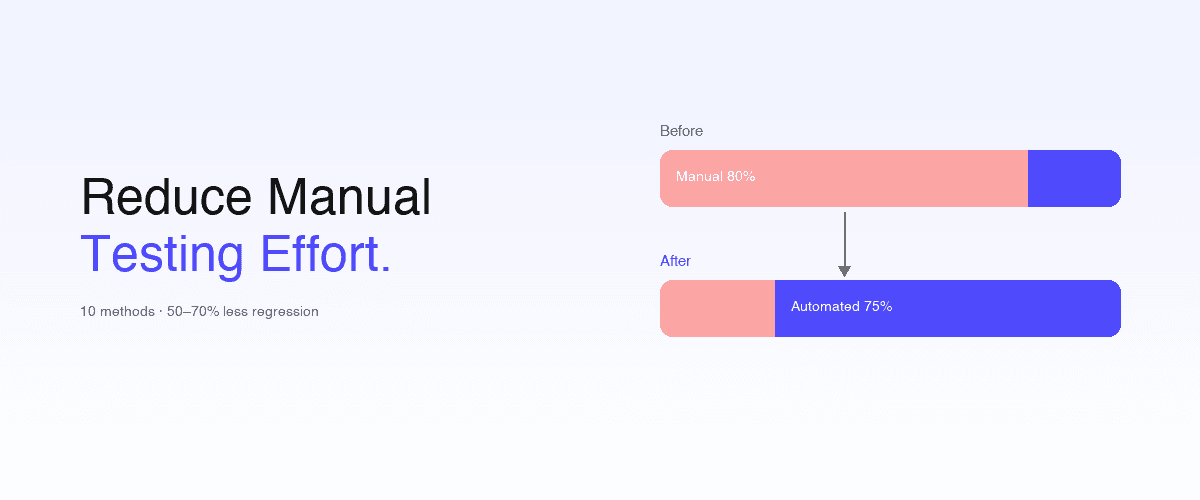
Traditional test automation executes selector-bound scripts that are costly to maintain, whether a human or a coding agent wrote them. AI automation tools generate tests, heal them when UIs change, and sometimes decide what to test, reducing manual authoring and maintenance. The most advanced ones, like Shiplight, operate agentically, closing the loop between code generation and quality verification.
Are AI automation tools ready for production use in 2026?
Yes. Enterprise codeless suites have run production estates for years, the visual and execution layers are long-established, and Shiplight is production-ready with SOC 2, enterprise deployments. The right question is not whether AI automation works, but which tool matches your workflow. See our agentic QA readiness checklist.
Which AI automation tool works best with AI coding agents like Claude Code or Cursor?
Shiplight AI installs across every major coding agent via MCP plus Skills, keeps tests as YAML in your git repo, and runs locally with no account. It exposes browser automation as MCP tools and test generation as skills, both called directly by Claude Code, Cursor, Codex, and GitHub Copilot. Other tools treat testing as a separate workflow, creating bottlenecks in AI-driven development.
Is there a free AI automation tool for software testing?
Playwright, Cypress, and Selenium are fully free and open source, but they're frameworks, not AI automation tools. Percy has a genuine free tier; Applitools offers a free trial only. Shiplight is free to install with no account, and local runs need no account. Commercial "free tiers" often gate real usage behind quotes, so check what execution costs first.
How do I migrate from an existing AI automation tool to Shiplight?
Most commercial platforms keep tests in proprietary cloud formats with lossy or no export, so migration usually means re-authoring, not importing. The fastest path: have your AI coding agent generate equivalent YAML tests from the same specs the originals were written against. Coverage rebuilds in days because the agent does the authoring. See the ACCELQ alternatives guide.