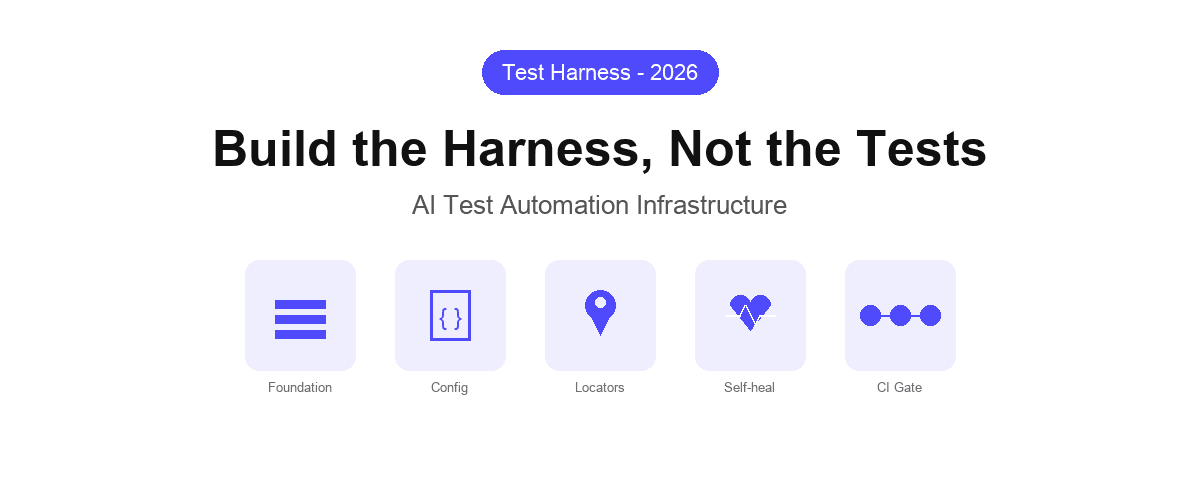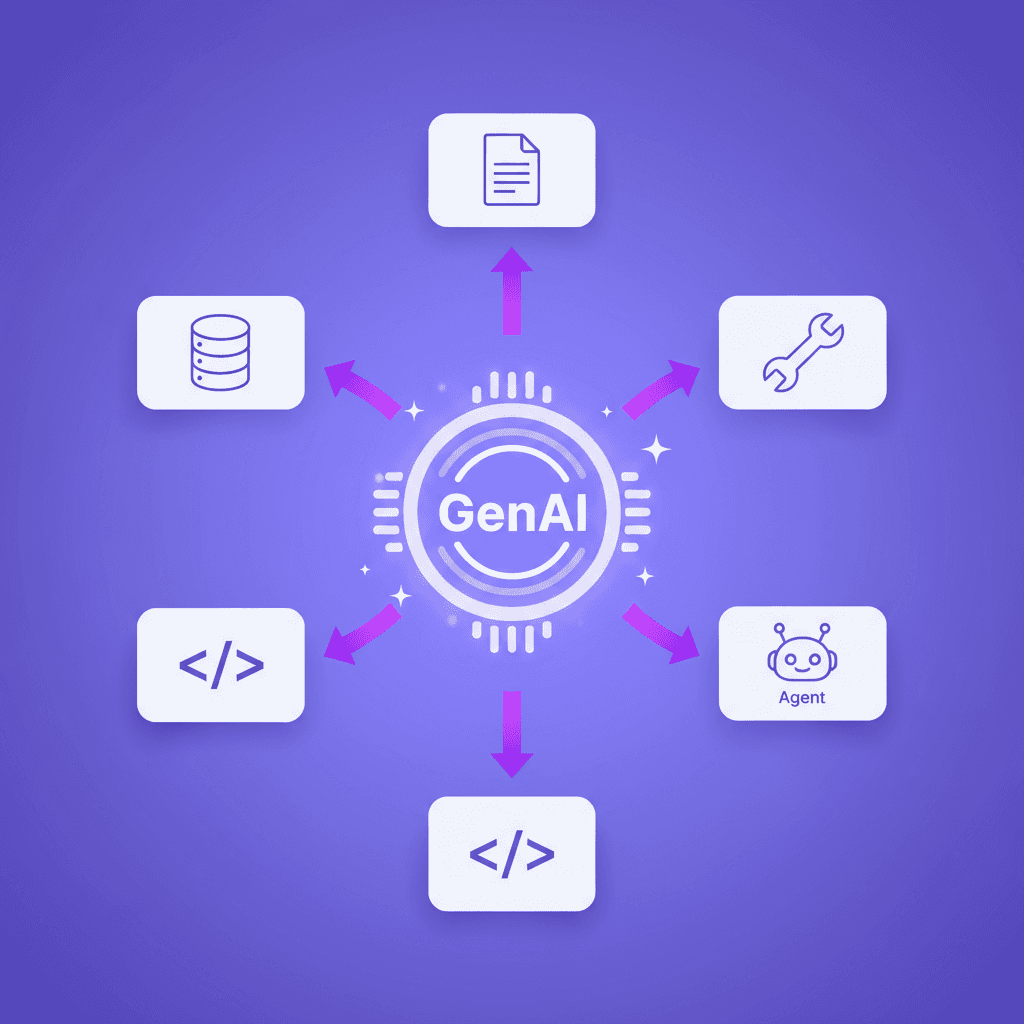
Generative AI in software testing refers to using large language models and related AI techniques to produce test cases, maintain tests, generate test data, interpret failures, and verify application behavior: replacing or augmenting the manual work engineers have historically done by hand. In 2026, five distinct applications have reached production maturity.
Generative AI is one technique within the broader category of AI testing, which also includes rule-based AI-augmented features and no-code authoring experiences.
Why this is different from earlier AI testing
Generative AI is the most impactful change to software testing since automation frameworks displaced manual QA.
Unlike earlier AI-augmented testing tools (which added smart locators or flakiness detection to fundamentally script-based frameworks), generative AI produces new artifacts from high-level inputs: test cases from specifications, healing patches from UI changes, tests from real user sessions, and executable verifications from natural language intent.
This guide explains what generative AI in software testing actually does in 2026, where each application is mature enough to trust in production, where it still struggles, and how to adopt it.
What Is Generative AI in Software Testing?
Generative AI is one technique within the broader practice; for the full lifecycle view (role, methods, benefits, pros and cons, tools), see AI in software testing: the complete guide.
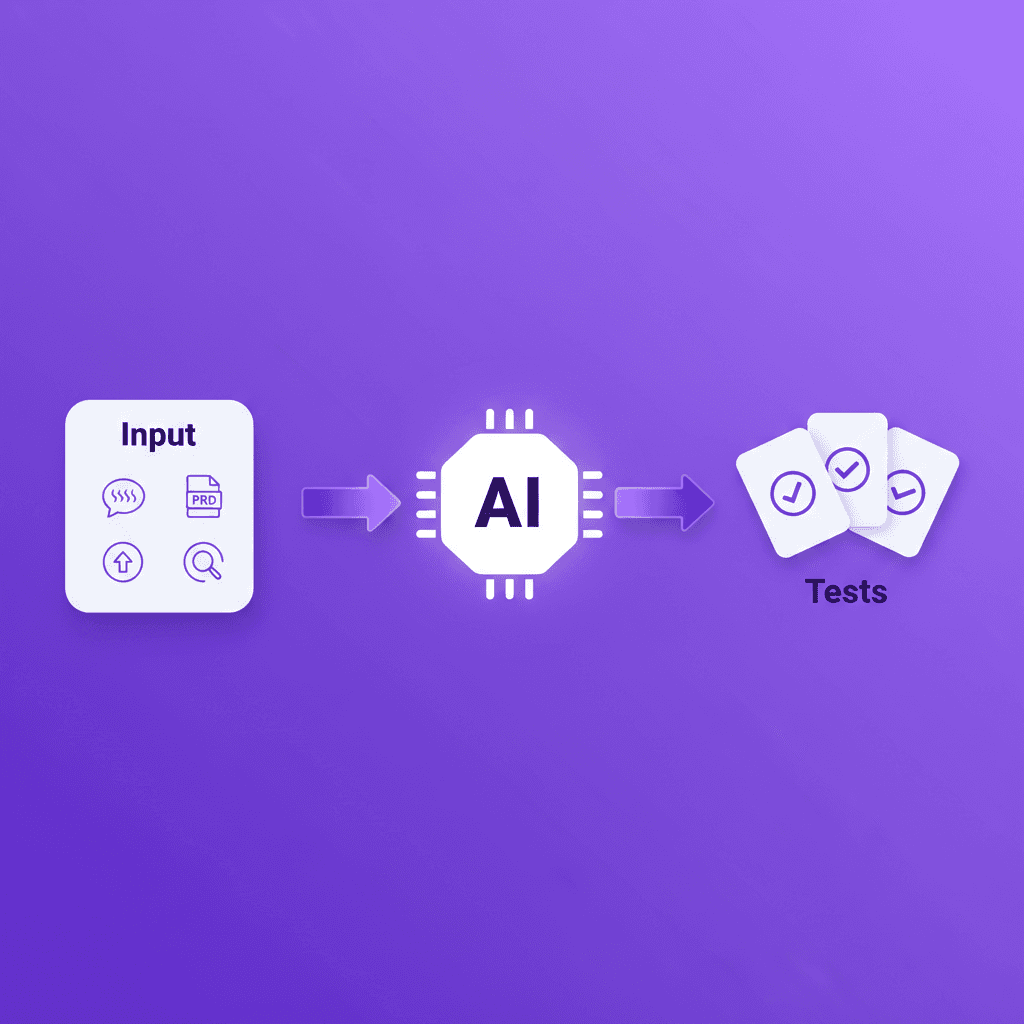
Generative AI is the category of AI models that produce new content (text, code, images, structured data) rather than classifying or predicting existing data. In software testing, the inputs are typically product specifications, user stories, source code diffs, UI states, or user session recordings. The outputs are executable test artifacts.
This differs from earlier applications of AI in testing:
| Type | What it does | Example |
|---|---|---|
| Rule-based automation | Executes human-written scripts | Selenium, Cypress |
| AI-augmented testing | Adds AI features to scripts (smart locators, flakiness detection) | Testim, AI modes in enterprise suites |
| Generative AI testing | Produces new test artifacts from high-level inputs | Shiplight, cloud-agent generation services |
The distinction matters because generative AI testing removes the manual authoring step, not just the maintenance step.
The 5 Applications of Generative AI in Software Testing
1. Test Case Generation
The most mature application. LLMs generate executable test cases from:
- Specifications: user stories, PRDs, acceptance criteria
- UI exploration: the AI navigates your application and generates tests for discovered flows
- Session recordings: real user traffic translated into test cases
- Code diffs: the AI reads a pull request and generates tests covering the new behavior
Each input type has tradeoffs. See our comparison of AI tools that automatically generate test cases for tool-by-tool breakdown, or what is AI test generation? for the conceptual foundation.
2. Self-Healing Tests
Tests that automatically repair themselves when the UI changes. Two generations:
- Locator fallback self-healing: rule-based, tries alternative selectors
- Generative self-healing: the AI re-resolves test intent from scratch when the original locator fails, using LLMs to identify the correct element from a natural-language intent description
Generative self-healing handles UI redesigns that locator fallback cannot. Shiplight uses the intent-cache-heal pattern: tests store the semantic intent, the AI resolves it at runtime, and healing succeeds even through component library migrations.
3. Agentic QA
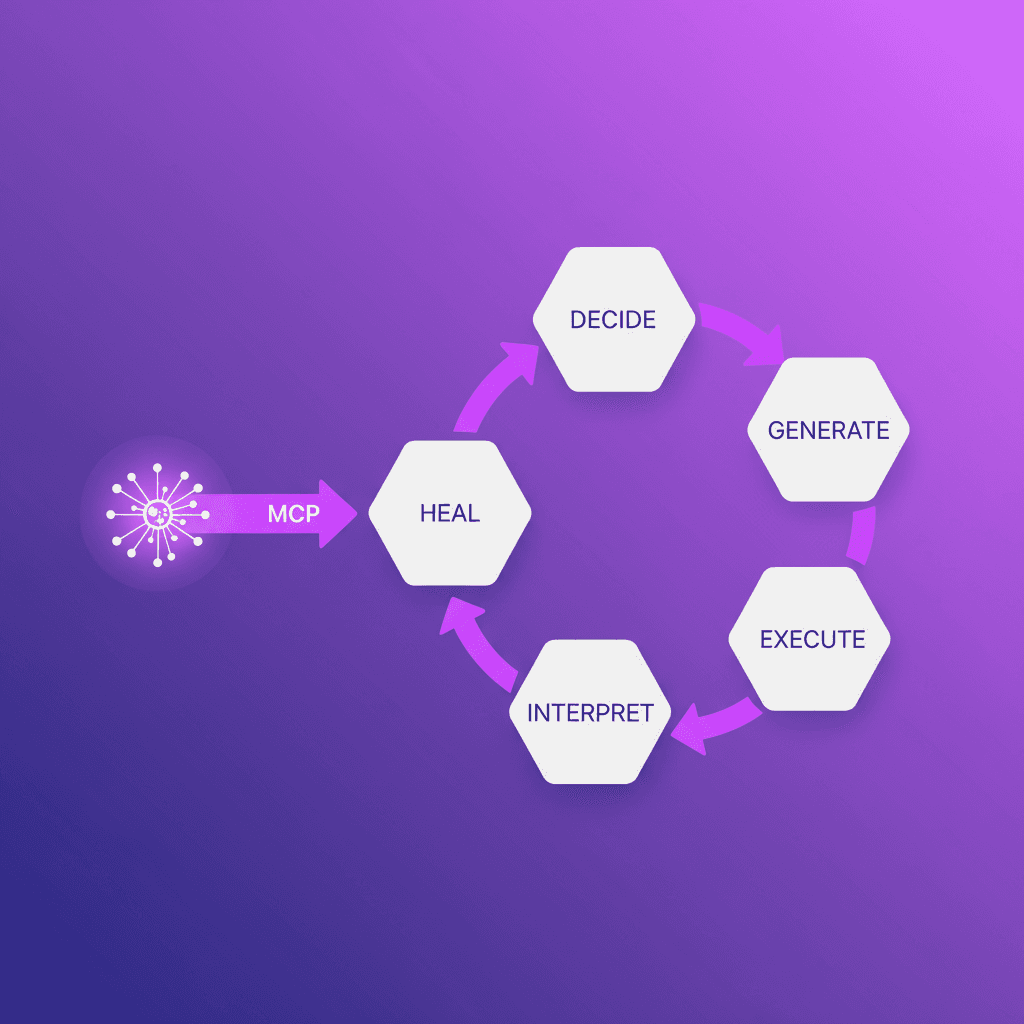
AI agents that handle the full QA loop autonomously (deciding what to test, generating tests, executing them, interpreting results, and healing broken tests) without human intervention at each step. See agent-native autonomous QA for the full paradigm and what is agentic QA testing? for the definition.
Agentic QA is where generative AI reaches its most complete expression in testing: not just generating artifacts, but operating as a peer in the development loop.
4. AI Coding Agent Verification
AI coding agents like Claude Code, Cursor, Codex, and GitHub Copilot generate code that still needs to be verified. Generative AI testing tools provide that verification layer: Shiplight exposes browser automation and test generation as Model Context Protocol (MCP) tools the coding agent can call during development.
This closes the loop between generative AI code production and generative AI quality verification. Both sides of the development workflow are now AI-driven. See how to QA code written by Claude Code for a concrete workflow.
5. Test Data Generation
LLMs generate realistic test data: synthetic users, product catalogs, transaction histories, edge-case inputs. This replaces hand-crafted fixtures and static data files with generated data that reflects realistic distributions and production-like patterns.
Test data generation is often invisible (it happens inside the other four applications rather than as a standalone product), but it's a significant productivity improvement over maintaining fixture files by hand.
Benefits of Generative AI in Software Testing
Faster test authoring
Writing a Playwright test by hand takes 30–90 minutes. Generating an equivalent test from a user story takes seconds. For teams shipping multiple features per day, this is the difference between shipping with coverage and shipping without.
Self-healing that actually survives UI changes
Traditional self-healing (locator fallback) breaks when UI designs change substantially. Generative self-healing re-resolves intent from scratch, so tests survive redesigns, component library migrations, and CSS framework changes that would break locator-based tools.
Coverage that scales with development velocity
When AI coding agents generate most of the code, manual test authoring becomes the bottleneck. Generative AI testing eliminates that bottleneck: the coding agent and the QA agent can both operate at development velocity.
Tests readable by non-engineers
Many generative AI testing tools output human-readable formats: plain English sentences, YAML with natural-language intent, or visual test specifications. Product managers, designers, and business analysts can review tests without understanding code. See no-code testing for non-technical teams for the practical implications.
Limitations and Risks
Hallucinated tests
LLMs sometimes generate tests that don't match the actual product behavior: verifying functionality that doesn't exist or passing on incorrect expected values. Human review remains necessary, especially for business-rule-heavy flows.
Opaque failure modes
When a generative AI system fails, the reasoning is often not inspectable. This creates debugging friction and compliance concerns in regulated industries.
Training data dependency
Generative AI testing tools are only as good as their underlying models. Model updates can improve or regress behavior without notice, and fine-tuned-on-your-app approaches require a training period before accuracy is production-ready.
Security and data residency
Generative AI tools typically send application state, DOM content, and sometimes screenshots to LLM providers. This introduces data residency, PII, and intellectual property considerations that didn't exist with self-hosted frameworks like Playwright.
Not a replacement for every test
Generative AI testing excels at UI-level E2E. Unit tests, integration tests, performance tests, and many types of security testing remain better served by specialized tools.
The State of Generative AI in Software Testing in 2026
Generative AI testing has matured from experimental to production-ready, but the category is fragmented. Different tools specialize in different applications:
| Tool or category | Primary generative application |
|---|---|
| Shiplight AI | Test generation + agentic QA + coding agent verification |
| Plain-English DSL platforms | Constrained plain-English test generation + self-healing |
| Low-code recorder platforms | UI exploration test generation + auto-healing |
| Session-based generation services | Test generation from real user sessions |
| Fine-tuned ML platforms | Application-specific ML test generation |
Most teams use a combination. See best AI testing tools in 2026 and best agentic QA tools for tool-level detail.
How to Adopt Generative AI in Software Testing
- Step 1Identify where generative AI pays off most for your team
- Step 2Run a 30-day pilot
- Step 3Expand by coverage, not by tool
- Step 4Establish governance
Step 1: Identify where your team gains most
| If your pain is… | Start with… |
|---|---|
| Writing new tests takes too long | Test case generation (intent-based) |
| Tests break constantly when UI changes | Generative self-healing |
| AI coding agents are shipping untested code | AI coding agent verification via MCP |
| QA is a release-cadence bottleneck | Agentic QA |
| Fixture data is stale or unrealistic | Test data generation |
Step 2: Run a 30-day pilot
Pick one critical user flow and implement it fully with the generative AI approach you chose. Measure: time to first test, healing success rate on intentional UI changes, and failure signal quality.
Step 3: Expand by coverage, not by tool
Once one flow works, add more flows using the same tool before adding additional generative AI applications. The pattern that works is vertical (deeper coverage) before horizontal (more tools).
Step 4: Establish governance
Define who reviews generative AI outputs, how test changes flow through code review, and what data leaves your environment. For regulated industries, see enterprise-grade agentic QA checklist.
Conclusion
Generative AI in software testing is not one thing: it is five distinct applications, each at different levels of maturity. Which one to adopt first depends on where your team's current bottleneck is: authoring, maintenance, coverage, or integration with AI coding agents.
For teams building with AI coding agents, Shiplight AI is purpose-built for all five applications in one platform: test generation, generative self-healing, agentic QA, coding agent verification via MCP, and test data generation. Tests live in your git repository, are readable by non-engineers, and survive UI changes via intent-based healing.
FAQ
What is generative AI in software testing?
Generative AI in software testing is the use of large language models and related AI techniques to produce new test artifacts (test cases, healing patches, test data, executable verifications) from high-level inputs like specifications, UI exploration, or source code. It differs from AI-augmented testing (which adds AI features to fundamentally script-based frameworks) by producing the tests themselves.
How is generative AI different from AI test automation?
"AI test automation" is a broad term that includes both AI-augmented (AI features in scripts) and generative AI (AI produces the tests). Generative AI is a subset that specifically generates new artifacts rather than enhancing existing ones. See best AI automation tools for software testing for a tool-by-tool comparison across the category.
Is generative AI testing production-ready in 2026?
Yes for most applications. Test case generation, generative self-healing, and agentic QA are in production at teams ranging from AI-native startups to enterprises. AI coding agent verification via Shiplight is newer but production-ready. Fully autonomous test interpretation (without any human review) is still emerging.
Can generative AI replace human QA engineers?
It replaces execution work, not judgment work. Generative AI handles authoring, maintenance, execution, and triage. Human QA engineers shift to setting quality policy, reviewing edge cases, and handling domain-specific judgment calls. Teams with generative AI typically see QA headcount stabilize while coverage grows, not decrease.
What are the biggest risks of generative AI in testing?
Hallucinated tests (AI generates tests for behavior that doesn't exist), opaque failure modes (hard to debug when AI reasoning is unclear), and data residency concerns (application state sent to LLM providers).
Mitigate with human review of generated tests, structured output formats that are inspectable, and enterprise-grade security controls. See best self-healing test automation tools for enterprises for the enterprise evaluation criteria.