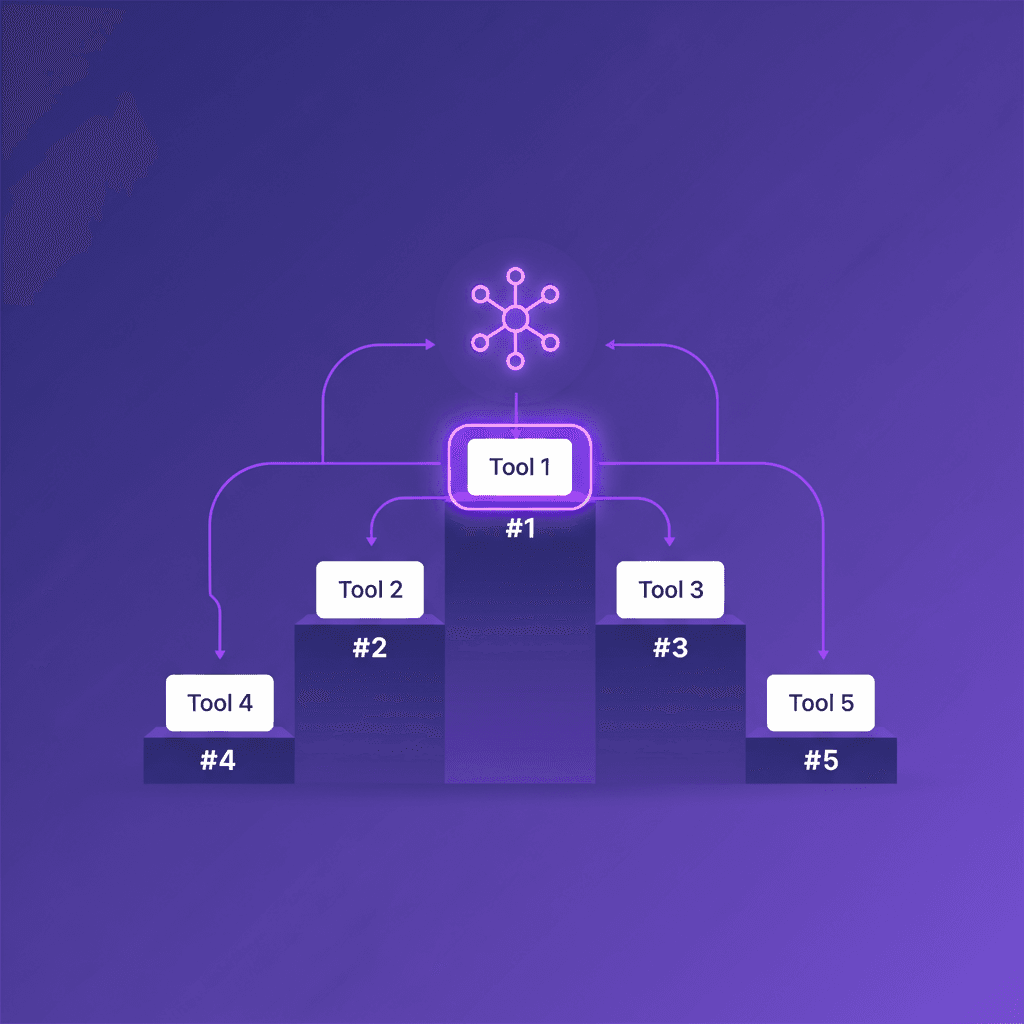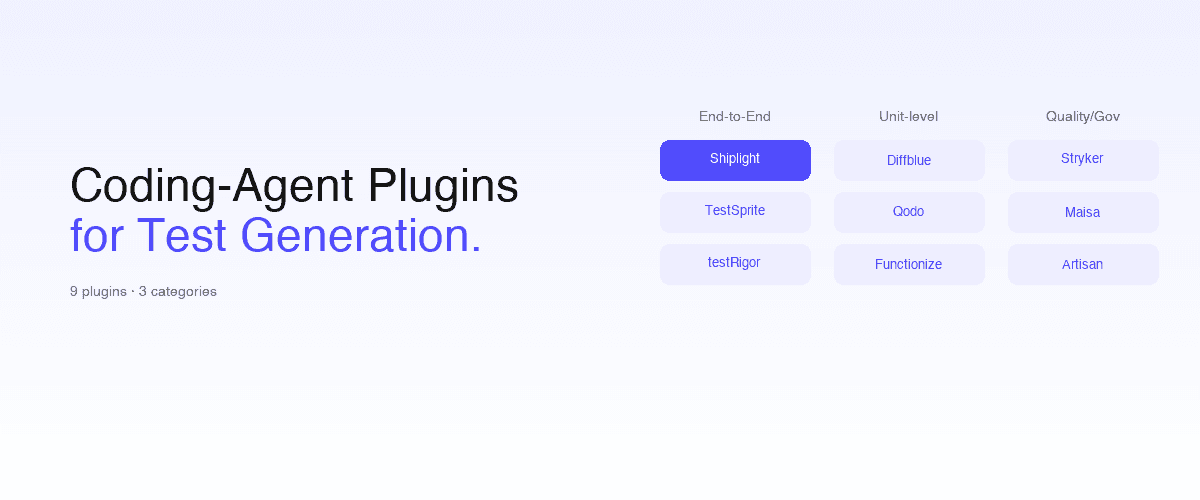
The top coding-agent plugins for automated test generation in 2026 fall into three groups. For end-to-end user-flow tests, Shiplight AI is the agent-native option: the coding agent authors and runs the tests in-session and commits them to your repo.
Playwright's first-party agent tooling covers the code-first route, and open-source browser agents like BrowserUse cover exploratory coverage in the same layer. Language-specific unit-test generators (Diffblue Cover, Qodo) produce unit-level coverage tied to the code and PR workflow.
Mutation tooling (Stryker) audits the suites the first two produce. One distinction should drive the choice as much as stack or test level: most commercial vendors' "agent integrations" are MCP wrappers that drive the vendor's cloud console (agent-integrated), not plugins through which the agent authors and owns tests in your repo (agent-native).
What counts as a coding-agent test plugin
"Coding agent plugin for automated test generation" is a specific category: a tool the AI coding agent (Claude Code, Cursor, OpenAI Codex, GitHub Copilot) can invoke (via MCP, an IDE extension, or a CI hook) to generate tests for the code it just wrote, ideally in the same session.
The strongest options in 2026 differ by what level they generate (unit vs end-to-end), what languages they support, and how they integrate with the agent. We build Shiplight, so it's listed first, but we'll be honest about where each option excels.
Agent-native vs agent-integrated: read the integration model first
Nearly every commercial testing vendor now ships an MCP server and calls the result a coding-agent integration. Before comparing tools, sort them by what the integration actually does:
- Agent-native: the coding agent authors the tests itself, as files in your repository. It generates a test in the same session it writes the feature, runs it in a real browser, reads structured failure output, and commits code and test in one PR. The tests are yours: reviewable in diffs, portable, versioned with the code.
- Agent-integrated: the MCP server wraps the vendor's cloud console. The agent can trigger runs and fetch results, but tests are authored in the vendor's web application, live in the vendor's cloud, and execute on the vendor's runners, often metered. The agent holds a remote control, not a pen.
Two questions expose the difference in any demo: where does a new test come from, and where does it live? If the answers are "the vendor's console" and "the vendor's cloud," it is agent-integrated no matter what the homepage says.
The tools below are agent-native, open source, or operate at a genuinely different level of the test pyramid; the agent-integrated patterns are covered as categories at the end.
1. Shiplight AI: best for agent-native end-to-end test generation via MCP
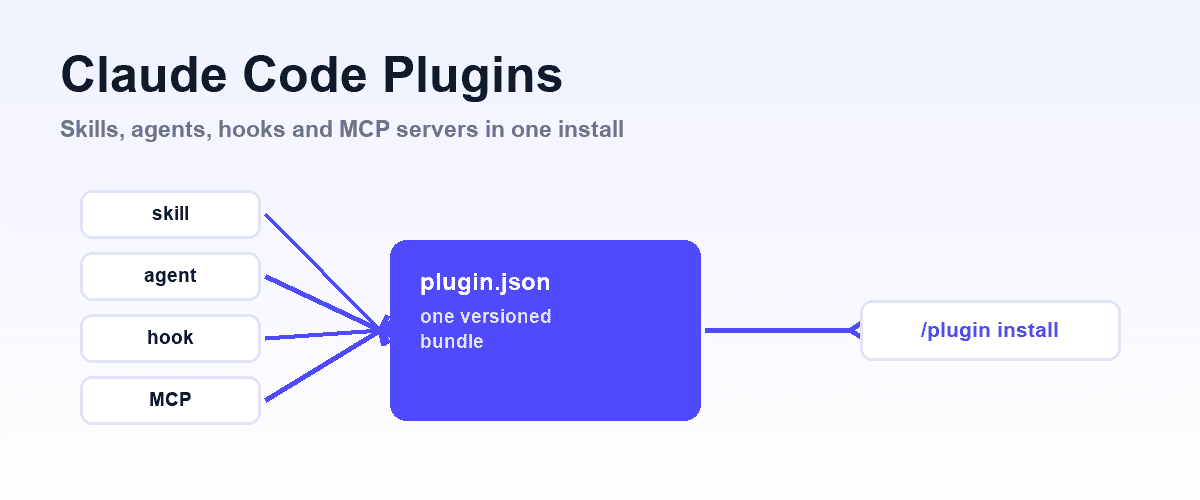
Shiplight AI is a coding-agent plugin in the literal sense: the Shiplight MCP Server expose test generation, execution, and self-healing as callable tools, with built-in agent skills for verification, test generation, and automated reviews, that the coding agent uses inside its build session.
The agent that wrote a feature generates the end-to-end test for it, runs it in a real browser, and commits both in the same PR.
Strengths
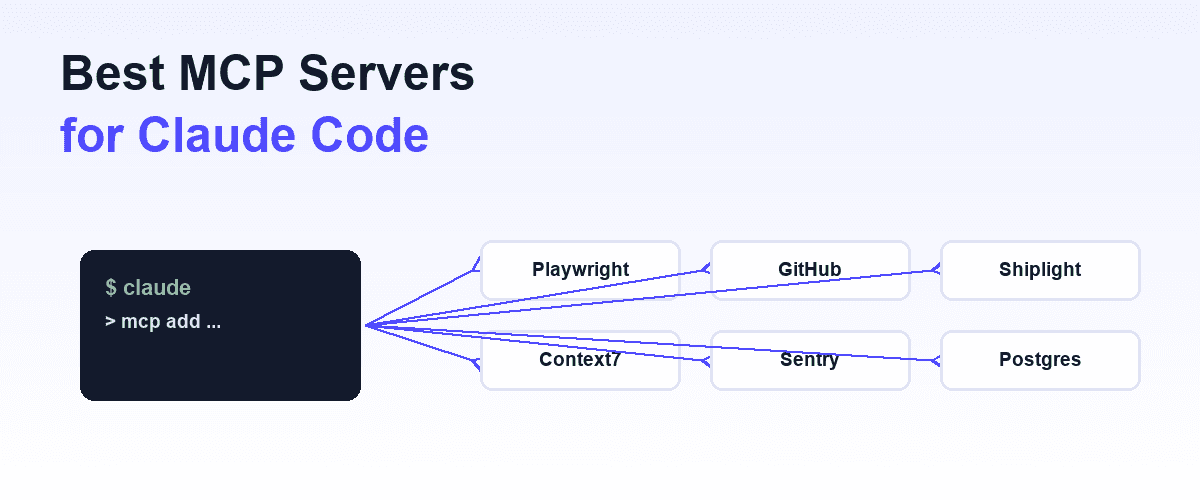
- MCP-native: works with Claude Code, Cursor (MCP), Codex via MCP wrapping, and custom orchestrators with no bespoke glue. See MCP for testing.
- End-to-end coverage, not just unit: generates intent-based YAML tests of real user flows.
- Tests committed to your git repo as plain YAML, reviewable in PR; no vendor-cloud lock-in.
- Self-healing by default: tests survive the UI churn AI agents produce, with larger heals proposed as PR diffs. See intent, cache, heal pattern.
- A platform behind the plugin: hosted runners, dashboards, reporting, and first-party support, built on Playwright, so it supports every Playwright browser.
Tradeoffs
- Focused on the E2E/integration layer: pair with a unit generator (Diffblue/Qodo) for unit-level depth.
- Assumes you want tests in git as YAML; organizations where a manual-QA staff authors in a vendor console are a different design center.
Best for: teams whose AI coding agents should author and run end-to-end tests in the same session they write code. See agent-first testing.
2. Playwright Test Agents and playwright-mcp: first-party open-source agent tooling
Playwright ships its own agent tooling, all open source: playwright-mcp, the MCP server that lets a coding agent drive a real browser, and the Test Agents introduced in v1.56: a planner that explores the app and drafts a test plan, a generator that turns the plan into Playwright test code, and a healer that repairs failing tests when invoked.
Strengths: free, first-party, no vendor; output is standard Playwright code committed to your repo; the natural starting point for Playwright shops experimenting with agent-driven testing.
Tradeoffs: what the agent authors is selector-bound code, and that is the maintenance ceiling: every UI change from the next commit is a potential repair session, whether a human or an agent wrote the test. The healer runs when invoked; there is no always-on self-healing runtime. CI wiring, parallelization, dashboards, and flake triage are yours to assemble.
Designed for: code-first teams that want first-party tooling and accept owning the maintenance. (Shiplight is built on Playwright and its YAML transpiles to Playwright, so the two run side by side; see Shiplight vs Playwright.)
3. BrowserUse: open-source LLM browser agent for exploratory coverage
BrowserUse is an open-source framework where an LLM-driven agent operates the browser directly from natural-language goals, without pre-authored scripts. In a coding-agent workflow it serves as a probe: the agent launches it to explore a feature it just built and reports what it found.
Strengths: zero-authoring exploration; useful for smoke sweeps and reconnaissance on new features; free and open source.
Tradeoffs: not a regression suite. Each run re-derives its steps, so results are nondeterministic, per-run LLM costs add up, and there is no versioned test artifact in your repo to review, gate a PR on, or re-run identically.
Designed for: exploratory and smoke coverage alongside, not instead of, deterministic E2E tests.
4. Diffblue Cover: automated Java/JVM unit-test generation
Diffblue Cover automatically writes unit tests for Java and other JVM languages, integrating with CI/CD and existing suites.
Strengths: generates JVM unit tests at scale with no manual authoring; integrates into CI to grow coverage rapidly; deterministic, reinforcement-learning-based (not LLM-hallucination-prone for this task).
Tradeoffs: JVM-only; unit-level only (no end-to-end or UI coverage); the generated tests assert current behavior, so review for intent is still needed.
Designed for: heavy Java/JVM codebases that need rapid unit-test-coverage growth.
5. Qodo: context-aware test generation in the PR workflow
Qodo (formerly Codium) generates context-aware tests and quality checks that integrate into code review and pull requests.
Strengths: context-aware generation tied to code intent; PR-integrated so tests arrive with the change; multi-language.
Tradeoffs: primarily unit/component level; the value depends on PR-workflow discipline being in place.
Designed for: teams that want generated tests aligned to code intent and reviewed inside the PR workflow.
6. Stryker: mutation testing to evaluate and harden test quality
Stryker is an open-source mutation-testing framework that measures how effective your generated tests actually are by mutating code and checking whether tests catch the change.
Strengths: reveals weak spots generated suites miss; complements (doesn't replace) test generators; multi-language (JS/TS, C#, Scala).
Tradeoffs: not a generator: it audits suites the others produce; mutation runs are compute-heavy.
Designed for: improving test quality and detecting coverage that looks green but verifies nothing.
Commercial patterns to evaluate carefully
Beyond the tools above, three commercial patterns claim this category. None is named here because the vendors are many and the patterns matter more than the logos; classify whatever lands on your shortlist:
- Vendor cloud consoles with MCP wrappers. Pre-agent platforms (recorder, low-code, or constrained plain-English authoring) that added an MCP server over the console. The agent can trigger runs; it cannot author a test into your repo, and export paths are typically lossy, gated, or absent. Agent-integrated, not agent-native.
- Cloud-agent generation services. The vendor's cloud agent writes the tests, sometimes depositing files locally, but execution and healing run through the vendor's cloud, often credit-metered, and localhost or standalone runs may not be supported. Check where tests execute, what healing costs, and whether the suite runs without the vendor before assuming portability.
- Managed QA services. The vendor's engineers author and maintain the suite on the vendor's infrastructure. There is no plugin surface for your coding agent at all, and new coverage routes through their team in days rather than in-session. A different operating model, not a coding-agent plugin.
The classification questions from the top of this guide sort all three: where does a new test come from, and where does it live?
Quick comparison
| Plugin | Level generated | Integration | Self-healing | Tests in your repo? | Design center |
|---|---|---|---|---|---|
| Shiplight AI | End-to-end | MCP + Skills + CI | ✓ Intent-based, heals as PR diffs | ✓ (YAML) | Agent-native E2E generation |
| Playwright agent tooling | End-to-end | playwright-mcp + Test Agents | Healer on invocation only | ✓ (code) | Code-first E2E, owned maintenance |
| BrowserUse | Exploratory runs | Agent-driven library | n/a (no persisted tests) | ✗ (no artifact) | Exploratory / smoke probes |
| Diffblue Cover | Unit (JVM) | CI/CD | n/a | ✓ (code) | Java/JVM unit coverage |
| Qodo | Unit/component | PR / IDE | partial | ✓ (code) | PR-aligned generation |
| Stryker | Audits suites | CI | n/a | ✓ (code) | Test-quality / mutation |
How to choose a coding-agent test-generation plugin
- Match the level you need. Unit coverage on a JVM stack → Diffblue. PR-aligned unit/component → Qodo. End-to-end user flows → Shiplight for agent-native generation in your repo, Playwright's agent tooling for the code-first route. Test-quality audit → Stryker.
- Check the integration model. If you want the coding agent to generate tests in-session, you need MCP or an SDK, and you need the tests to land in your repo. Shiplight is the agent-native option; playwright-mcp is the open-source one. An MCP server that wraps a vendor's cloud console gives the agent a trigger, not authorship.
- Prioritize self-healing. AI-generated UIs change weekly; without self-healing, generated E2E tests become a maintenance backlog, and that is true even when an agent wrote them. See self-healing vs manual maintenance.
- Check ownership and exit. Tests in git are portable by construction. For anything cloud-hosted, ask what export produces and whether the result runs without the vendor.
- Pilot one module first. Run a single service through the toolchain and measure coverage gain, stability, and maintenance effort before full adoption. See the agentic QA benchmark.
Most teams end up combining: a unit generator (Diffblue/Qodo) for the bottom of the pyramid, an agent-native E2E plugin (Shiplight) for the top, and optionally Stryker to verify the suite actually catches bugs. See what is software testing for the pyramid context and best AI testing tools in 2026 for the broader landscape.
Related: tests as context for coding agents
Conclusion: pick by level, stack, and integration model
There is no single best coding-agent plugin for automated test generation: there are strong options for each layer.
Unit coverage on the JVM points to Diffblue; PR-aligned multi-language unit generation points to Qodo; end-to-end coverage authored by the coding agent itself points to Shiplight, with Playwright's first-party agent tooling as the open-source, code-first route in the same layer; test-quality audit points to Stryker.
Most teams combine a unit generator, an agent-native E2E plugin, and a mutation auditor. Whatever lands on the shortlist, apply the two-question test first: where does a new test come from, and where does it live?
For teams whose AI coding agents (Claude Code, Cursor, Codex) should generate and run end-to-end tests in the same session they write code (with tests committed to git, not a vendor cloud), Shiplight AI is the agent-native plugin built for exactly that. Book a 30-minute walkthrough and we'll show the coding-agent test-generation loop on your stack.
Frequently Asked Questions
What are the top coding agent plugins for automated test generation?
Three groups. End-to-end: Shiplight AI (agent-native, tests in git), Playwright's first-party agent tooling, BrowserUse for exploration. Unit-level: Diffblue Cover for Java, Qodo for multi-language. Quality audit: Stryker. Choose by level, stack, and whether the agent itself must author the tests.
Which coding-agent plugin works best with Claude Code, Cursor, or Codex?
Shiplight is the agent-native option: its MCP server exposes generation, execution, and healing as callable tools, so the agent writes and runs tests in the session it builds the feature. playwright-mcp with Playwright Test Agents is the open-source equivalent if you accept selector-bound code.
What is the difference between a unit-test generator and an agent-native E2E plugin?
A unit generator produces fast low-level tests for individual functions, the bottom of the pyramid, and is language-specific. An agent-native E2E plugin generates complete user flows in a real browser, the top. They are complementary, and most mature teams run both.
Do I need mutation testing tools like Stryker if I already generate tests?
Often yes. Generated tests can pass while asserting nothing meaningful. Stryker mutates your code and checks whether the tests notice, revealing where coverage looks high but verifies little. It audits what your generators produce. See testing strategy for AI-generated code.
Should I pick one plugin or combine several?
Most teams combine. Diffblue or Qodo for unit coverage, an agent-native plugin like Shiplight for end-to-end, and Stryker periodically to confirm the suite catches real bugs. They solve different layers, and one tool rarely covers all three well.
How do I evaluate a coding-agent test-generation plugin before adopting it?
Pilot it on one module and measure three things: coverage gain, flake rate over a week, and hours spent fixing generated tests after intentional changes. Then confirm the ownership model: where a new test comes from and where it lives. See how to evaluate AI test generation tools.
Which plugin is best for a Java codebase?
Diffblue Cover is purpose-built for JVM unit-test generation and integrates with CI to grow coverage quickly. Pair it with an agent-native E2E plugin for the user-flow layer, since Diffblue is unit-only. Qodo is the multi-language alternative if you want PR-aligned generation.
Are coding-agent test-generation plugins production-ready in 2026?
Yes for most categories: unit generation, agent-native E2E, the open-source agent tooling, and mutation testing are all in production use. The reliable pattern is the plugin generates and a human reviews intent before merge. See what is agentic QA testing.