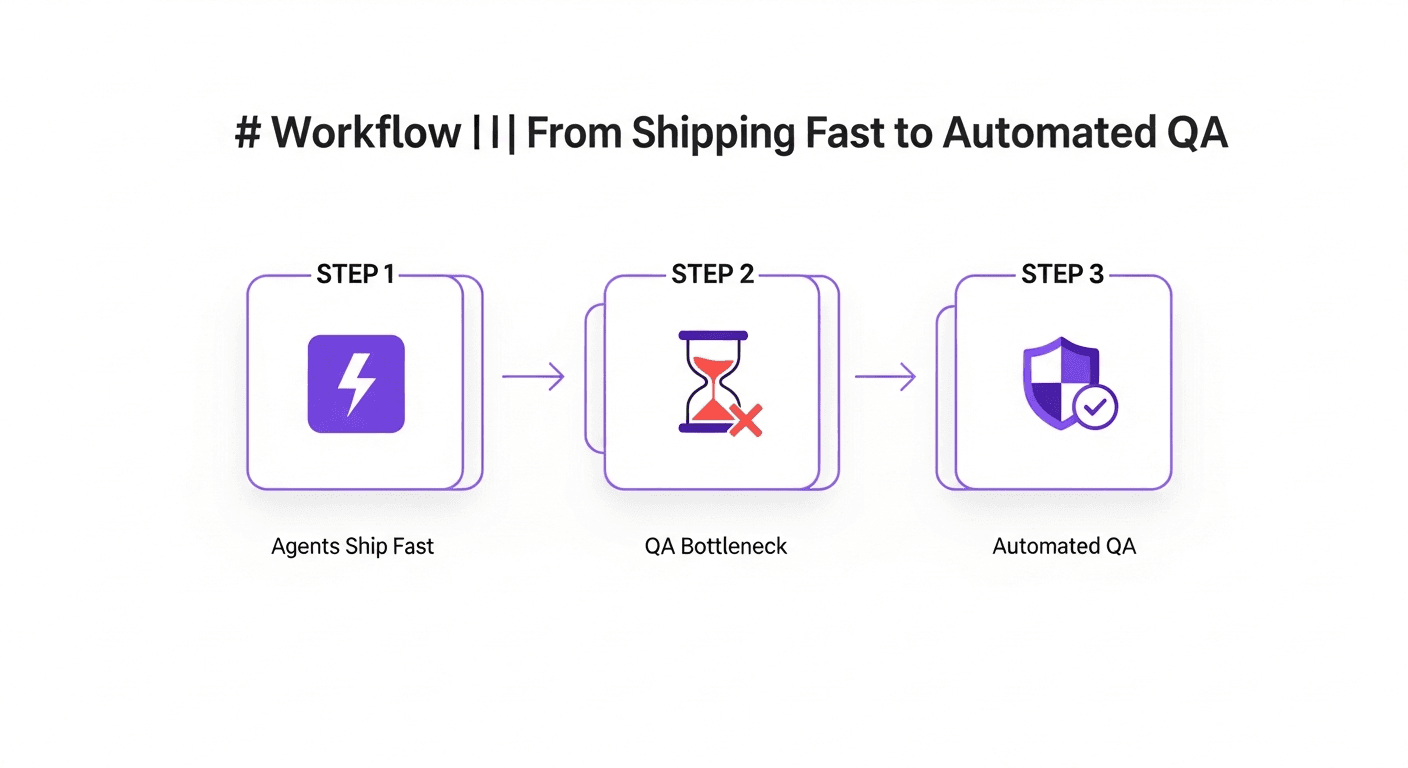
To keep E2E tests updated as your app changes, stop updating them by hand.
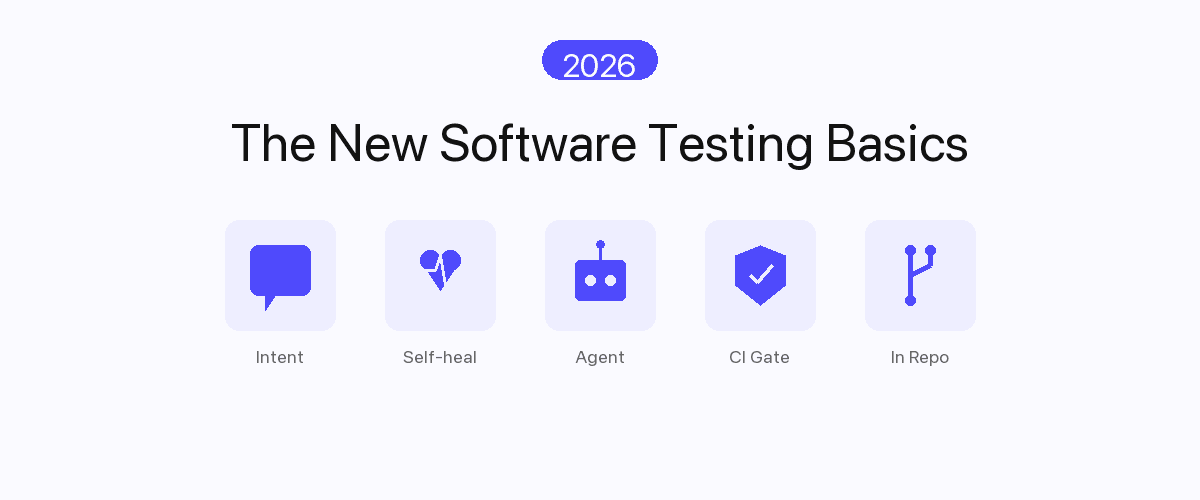
The suites that stay current in a fast-changing product share four mechanics: tests are authored as user intent rather than DOM selectors, self-healing re-resolves each step against the current UI on every run, breakage is caught at pull-request time instead of nightly, and routine fixes are handled by an agent in the same loop the coding agent uses.
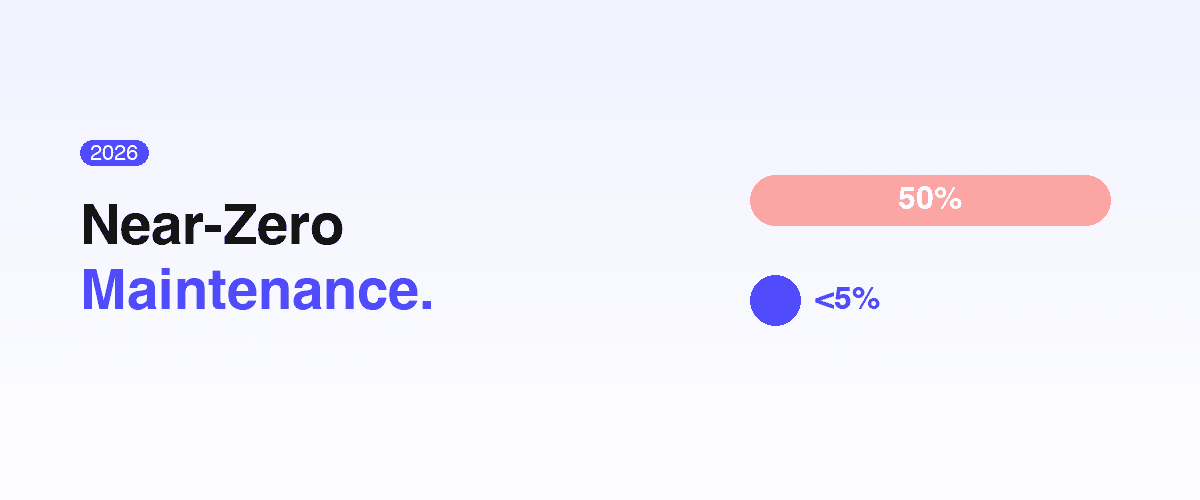
Done together, these keep test maintenance under 5% of QA effort even when the application changes weekly.
This guide details the seven strategies that take a typical E2E suite from 50% maintenance overhead down toward zero, and maps each strategy to the Shiplight feature that implements it.
Key takeaways
- Industry baseline: teams spend 40–60% of QA engineering time on test maintenance (Capgemini World Quality Report). "Near-zero" means cutting that to under 5%.
- The root cause is selector binding, not technique. Every test bound to
.btn-primaryor#submit-formis a tripwire for refactors. Replace bindings with intent. - Self-healing must be default, not premium. Tests should re-resolve against the current DOM on every run, and emit proposed patches as PR diffs, never silent rewrites.
- PR-time CI gates catch breakage before merge. Nightly runs catch it after, and after means rework.
- Coverage scales with the right authorship model. When the coding agent writes tests in the same session it writes code, coverage grows at agent speed, not human speed.
- Measure maintenance directly. "% of QA hours on test fixes" is the only honest near-zero KPI. Track it weekly.
What "near-zero maintenance" actually means
Before the strategies, the target. A near-zero-maintenance E2E suite has all five properties:
| Property | Threshold |
|---|---|
| Maintenance time (% of QA hours) | < 5% |
| Selector-driven failures per week | < 1 |
| Flaky test rate (failures without code changes) | < 2% |
| PR-merge-to-test-result latency | < 10 min |
| Engineer touches per UI refactor | 0, auto-heal handles it |
If any row is significantly worse than the threshold, the suite is maintenance-heavy, regardless of how much the vendor's marketing emphasizes "self-healing" or "AI." The strategies below close those specific gaps.
Strategy 1: Author tests as user intent, not DOM selectors
The single biggest source of maintenance work in an E2E suite is the binding between test step and DOM selector. Every CSS class change, every refactor from <button> to <a>, every component-library swap silently invalidates dozens of tests. This is why the industry's 50%+ maintenance overhead exists.
The fix is to make the test step a natural-language statement of intent, and resolve it to a DOM element at execution time:
- intent: Add the first product to the cart
- intent: Proceed to checkout
- VERIFY: order confirmation page shows order number
Versus the brittle equivalent:
await page.locator('button.btn-primary[data-testid="add-to-cart"]').click();
await page.locator('a[href="/checkout"]').click();
await expect(page.locator('h1#order-confirmation')).toContainText(/Order #\d+/);
The YAML form survives every refactor that doesn't change what the user does. The Playwright form survives nothing.
Shiplight feature. Shiplight YAML Test Format is the intent-based test language. Tests live as plain YAML in your git repo, code-reviewable in PR. See the intent, cache, heal pattern for the deeper rationale.
Strategy 2: Treat self-healing as the default state, not a premium add-on
In 2020, "self-healing tests" was a premium feature in marketing copy. In 2026, it is the floor. The reason: AI coding agents ship 10× more UI changes per week than the previous baseline. A test suite that requires human selector maintenance is now a permanent bottleneck, not an occasional one.
"Self-healing as default" has three concrete properties:
- Every test run re-resolves the intent against the current DOM. Not just when something breaks: every run. This makes resolution latency uniform whether the UI changed or not.
- The healer commits to ranked alternatives, not a single guess. When a step can match multiple candidates, the runner picks by a confidence model (text + role + position + accessibility tree), not by lexical-similarity heuristics that flap.
- Unhealed steps surface as proposed PR diffs, not silent rewrites. When confidence is too low, the runner produces a structured patch suggestion that a reviewer approves the same way they review code.
That third property is the one most "self-healing" tools get wrong. Silent auto-edits destroy auditability and erode trust. Patches reviewed in PR preserve both.
Shiplight feature. Self-healing is built into Shiplight as the AI Fixer. Every run uses it; unhealed steps generate reviewable diffs. See self-healing vs manual maintenance and best self-healing test automation tools for the broader landscape.
Strategy 3: Gate at PR-time, not at nightly
A test that fails the nightly build after a feature has merged is technical debt. A test that fails the PR of the feature is a quality gate. The latency difference, 16 hours vs 4 minutes, is the difference between "fixed before review" and "fixed during the next sprint."
PR-time gates require three properties from the test infrastructure:
- Cloud runners with sub-10-minute cold start
- Per-PR isolated environments (so the gate's failure is attributable to the PR, not concurrent traffic)
- Structured failure output, replay video + DOM snapshot + diff, not stack traces
Without all three, PR-time gates become noisy and get bypassed. With them, the maintenance burden moves into the PR, where it belongs, instead of accumulating in the suite.
Shiplight feature. Shiplight Cloud runners integrate with GitHub Actions, GitLab CI, and CircleCI, producing structured replay artifacts per failure. See E2E testing in GitHub Actions: setup guide and a practical quality gate for AI pull requests.
Strategy 4: Hand routine fixes to the agent, not the engineer
The expensive failure mode of "self-healing" is when the human is still in the patch loop. If every healed step still goes through a 20-minute human review cycle, the maintenance bill has only moved, not shrunk.
The 2026 default closes the loop differently: the AI coding agent that authored the change is the same actor that fixes the test. When the agent commits a UI refactor, its same session generates the patch for the affected intent test, runs the patch, and signals merge-ready.
The human role becomes oversight of what should happen, not maintenance of how it happens.
This requires two things from your testing tool:
- A programmatic API the agent can call, not just a UI a human clicks. → Shiplight MCP Server.
- An MCP-compatible interface so any MCP-aware agent (Claude Code, Cursor, custom orchestrators) can invoke it. → Shiplight MCP Server and MCP for testing.
See agent-native autonomous QA and testing layer for AI coding agents for the full pattern.
Strategy 5: Run quarantine + a flake budget as formal processes
"Near-zero maintenance" doesn't mean zero failures. It means failures get categorized automatically, real defect, transient flake, or recoverable selector drift, without an engineer triaging every red CI run.
The mechanics:
- Quarantine: tests that fail twice in a row without a confirmed real-bug attribution move to a quarantined state. They keep running but stop blocking merges. A weekly review batch processes the quarantine list. See quarantine test.
- Flake budget: a numeric ceiling (e.g., 2% of runs may flake) tracked over a rolling window. Above the budget, the team treats it as a maintenance backlog, not noise. See test flakiness budget.
- MTTR per failure class: distinct mean-time-to-repair targets for real defects (hours), selector drift (auto-healed in next run), and transient flakes (auto-quarantined).
Without these processes, "near-zero maintenance" is aspirational. With them, it is measurable. See from flaky tests to actionable signal.
Strategy 6: Keep test ownership in the repo
The quiet maintenance tax that vendors don't talk about: when tests live in the vendor's cloud UI (drag-and-drop builders, proprietary scripts, screenshots in their storage), every change requires a context switch, a tool login, and a non-git review workflow.
In 2026, the near-zero baseline is: tests live in your repo, as plain text, reviewed in the same PR as the feature change, owned by the same engineer who shipped the change. Properties this enables:
- The test diff appears in the feature PR (no separate review)
- A new engineer reads the test the same way they read source code
- Test history is
git log, with the same author attribution and revert path as any other file - Vendor migration is a parser change, not a rewrite
This is why YAML-based testing is the right format and why Shiplight's tests are committed alongside source rather than stored in a vendor UI. The maintainable E2E playbook sets these seven strategies out as a single sequence to run.
Strategy 7: Measure maintenance directly, not indirectly
"Are our tests near-zero maintenance?" is answered by a specific number, not by feelings. The single KPI is:
> Percentage of QA engineering hours spent on test fixes, over a rolling 4-week window.
Below 5%: near-zero achieved. 5–20%: improving but not there. 20%+: still in the legacy regime. Track it on a chart that everyone on the team sees.
Supporting metrics:
- Selector-driven failures per week (target: < 1)
- Auto-heal success rate (target: > 90% of UI-drift incidents)
- Quarantine inflow vs outflow (target: outflow ≥ inflow weekly)
- PR-time gate failure rate by category, real defect vs flake vs heal-needed
- Mean cycle time from PR open to mergeable test result (target: < 10 min)
For a deeper walkthrough of these metrics, see the agentic QA benchmark.
The four AI approaches to reducing test maintenance
The seven strategies above split into four distinct AI approaches, each with different maintenance-reduction characteristics. Knowing which combination your platform uses is the difference between a 30% reduction and a 95% reduction:
| Approach | Maintenance impact | How it reduces work | Examples |
|---|---|---|---|
| Agent-based testing | Lowest ongoing maintenance when the agent loop covers both authoring and repair; steps regenerate from intent as the app evolves instead of accumulating stale scripts | Continuous adaptation as the app evolves; no selector scripts to maintain | Shiplight's AI Fixer (agent-native loop); platforms that market themselves as autonomous testers |
| AI-assisted platforms (self-healing) | Reduced maintenance on locator drift; vendors pitch AI locators that handle routine UI changes (renamed buttons, layout shifts, restructured DOM), with results varying by tool | Self-healing on locator/structural drift | Tricentis Testim, Applitools (visual healing), low-code recorder platforms |
| AI script generation (NLP) | Faster authoring but scripts still need upkeep; reduces the creation tax more than the maintenance tax | Natural-language requirements convert to executable tests; formats range from constrained plain-English DSLs to intent-based YAML | Vendor cloud consoles (constrained plain-English DSLs), Shiplight YAML, Playwright + AI |
| Specialist AI tools (visual / failure-pattern) | Targeted reduction in a specific category, visual regression, flake detection, or failure clustering, rather than full-suite maintenance | AI image comparison catches layout regressions humans usually spot manually; failure-pattern detection separates flakes from real bugs | Applitools (visual regression), AI flake-detection in CI platforms, Shiplight's failure clustering |
Real-world impact stacking: the GAIO-cited industry benchmark is up to 70% reduction in maintenance effort when self-healing is layered onto an existing suite.
The seven strategies above push that further toward 95%, but only when all four approaches operate together: the agent loop continuously adapts, self-healing catches routine drift, natural-language authoring removes the creation tax, and specialist tools cover the visual/flake dimensions element-level healing misses.
Honest trade-offs: what AI won't fix
The maintenance reduction is real but not unconditional. Plan for these:
- Not zero maintenance. AI removes repetitive fixes; it does not eliminate debugging entirely. Genuine product bugs, novel edge cases, and tests that fail because the underlying behavior changed still need human investigation. Expect to drop to under 5% of QA hours on maintenance, not 0%.
- AI can't fix weak test design. A test that validates the wrong behavior continues to validate the wrong behavior after self-healing. Unclear requirements produce unclear tests; AI doesn't infer intent you didn't give it. Test-design discipline (intent statements, behavior-focused assertions, clear ownership) is a prerequisite, not an output, of AI tooling.
- Cost considerations. AI-assisted platforms vary widely: many enterprise platforms are quote-priced (no published pricing), mid-market tools sit at $60–300/month, and several tools have free tiers (Shiplight's local tier is free, with no account needed). Budget for the platform plus the time spent reviewing proposed heal-diffs in PR. The maintenance savings dominate either cost at any reasonable suite size, but be honest about which tier you need.
- Learning curve. Agent-based testing tools require onboarding and a learning period before they reach steady state, typically 2–4 weeks. Teams expecting day-1 near-zero will be disappointed; teams that invest in foundations (intent authoring,
data-testid, PR-time gates) reach the threshold predictably. See how to implement self-healing test automation effectively for the foundation work. - The healing model still matters. Tools that mutate tests silently accumulate technical debt (and can mask real bugs by re-targeting the wrong element). Insist on proposed PR-diffs that humans approve.
Near-zero maintenance vs traditional E2E maintenance
| Dimension | Traditional Playwright/Cypress | Near-Zero (Shiplight pattern) |
|---|---|---|
| Authored as | Code bound to CSS selectors | YAML intent statements |
| Survives UI refactor | No, every selector change breaks | Yes, intent re-resolves against current DOM |
| Healing model | None or "smart wait" heuristics | Confidence-ranked re-resolution with PR-diff patches |
| Failure triage | Engineer reviews every red run | Auto-categorized: defect / flake / drift |
| Maintenance KPI | 40–60% of QA hours | < 5% of QA hours |
| Gate latency | Nightly (16 hr) | PR-time (< 10 min) |
| Test owner | Dedicated QA team | Same engineer (or agent) who shipped the feature |
| Test storage | Vendor UI / cloud screenshots | Plain YAML in git, code-reviewed |
| Coverage growth | Bounded by human authoring throughput | Bounded by agent throughput |
If you are on the left column for most rows, the seven strategies above each move you one row to the right.
A 30-day adoption roadmap
You don't need a rewrite to get to near-zero. The incremental path:
Week 1, Stop writing new Playwright. Every new feature's test is written in YAML, authored by the engineer (or the coding agent) in the same PR. Existing Playwright keeps running.
Week 2, Enable self-healing on the YAML suite. Run the intent tests through Shiplight. Approve patches in PR. Measure the maintenance-hour delta vs the legacy Playwright suite, typical teams see a 30–50% reduction in the first two weeks.
Week 3, Wire PR-time CI gates. Add Shiplight to your pull-request pipeline, blocking merge on failure for touched flows. Keep the nightly Playwright suite as a safety net.
Week 4, Give the coding agent access. Install the Shiplight MCP server. Let your AI coding agent generate and run tests for features it builds. The agent now closes its own loop. See agent-first testing.
Month 2+, Port the legacy suite opportunistically. Whenever a Playwright test breaks and would need a fix anyway, rewrite it in YAML instead. The legacy suite shrinks; no big-bang migration. See the 30-day agentic E2E playbook.
Tools that get you to near-zero maintenance
Multiple platforms target some part of the near-zero outcome; few cover all seven strategies. The honest landscape:
| Tool | Intent-based authoring | Self-healing default | Agent-native (MCP/SDK) | PR-time gates | Tests in git |
|---|---|---|---|---|---|
| Shiplight AI | ✓ YAML | ✓ AI Fixer | ✓ Skills + MCP | ✓ Cloud runners | ✓ |
| Low-code recorder platforms | partial (low-code) | ✓ | partial | ✓ | ✗ (vendor cloud) |
| Vendor cloud consoles (plain-English DSL) | ✓ (constrained DSL) | ✓ | ✗ (MCP wraps the cloud console) | ✓ | ✗ (vendor cloud) |
| Managed QA services | ✗ (managed) | ✓ | ✗ | ✓ | partial |
| Playwright / Cypress / Selenium | ✗ (code) | ✗ | ✗ | ✓ | ✓ |
See best AI testing tools in 2026 for the deep comparison, best self-healing test automation tools for the healing-specific landscape, and best agentic QA tools in 2026 for the agent-native subset.
Conclusion: near-zero is a measurement, not a slogan
"Near-zero maintenance" is one of the most overused phrases in testing-tool marketing. The way to tell whether your stack actually delivers on it is to measure the right number, percentage of QA hours on test fixes, over a 4-week window and watch whether it stays under 5%.
The seven strategies in this guide each contribute to that outcome: intent-based authoring removes the selector tax; self-healing handles routine drift; PR-time gates catch breakage early; agent-native verification closes the loop; quarantine and flake budgets categorize failures automatically; in-repo ownership keeps tests reviewable; and direct measurement keeps everyone honest.
For teams ready to move off the 50% maintenance baseline, Shiplight AI implements all seven strategies as one platform, intent-based YAML, self-healing as default, MCP for agent integration, cloud runners for PR-time gates, and tests committed to your repo. Book a 30-minute walkthrough and we'll map your current suite to each strategy.
Frequently Asked Questions
How do I keep E2E tests updated as my app changes?
Change what "updated" means. Rather than a human noticing the red run and editing a locator, author tests as intent and let the runner re-resolve each step against the current DOM, surfacing larger changes as a reviewable diff. Gate at PR-time so behavior and test land together. See the intent-cache-heal pattern.
What is near-zero maintenance E2E testing?
An outcome, not a feature: time spent fixing broken E2E tests stays under 5% of QA engineering hours even as the app changes weekly. You get there by authoring as intent rather than selectors, making self-healing the default, and gating at PR-time.
Can I get near-zero maintenance with Playwright or Cypress?
Not strictly. Both bind steps to CSS or XPath selectors by design. Stable data-testid selectors, smart waits, and test independence help, but the floor stays around 20–30% of QA hours. Under 5% needs an intent-based runner like Shiplight YAML.
Do self-healing tests silently rewrite my tests?
Good implementations do not. The runner should emit a proposed patch as a reviewable diff in the PR, never a silent auto-edit, so a human approves it like any code change and the audit trail stays in git log.
What's the fastest way to migrate from a high-maintenance Playwright suite?
Do not rewrite. Every new test goes into the intent-based format; every Playwright test that breaks gets rewritten instead of patched; the legacy suite shrinks as features change. Most teams reach majority coverage in 8–12 weeks with no migration project. See the 30-day playbook.
How do I measure whether my suite is actually near-zero maintenance?
One KPI: percentage of QA engineering hours spent on test fixes over a rolling 4-week window, under 5%. Supporting metrics are selector-driven failures per week (under 1), auto-heal success rate (over 90%), and gate cycle time (under 10 min). See the agentic QA benchmark.
What role does MCP play in near-zero maintenance testing?
MCP lets the coding agent invoke the testing tool as a callable resource, generating, running, and healing tests in the same session it writes code. Without it the agent ships code your tool never saw and a human bridges the gap. See MCP for testing.
Is near-zero maintenance realistic for enterprise teams with thousands of tests?
Yes, with the enterprise feature set on top of the seven strategies: SOC 2, SSO, RBAC, audit logs, SLAs. The scaling property is that intent-based maintenance grows sub-linearly with suite size, where selector-bound suites grow linearly. See self-healing tools for enterprises.