AI-native software testing refers to testing approaches and tools built around AI from the ground up, such as Shiplight, rather than traditional test automation with AI added on.
In an AI-native system, AI actively generates, maintains, executes, and interprets tests as part of the development lifecycle, rather than serving only as a helper feature.
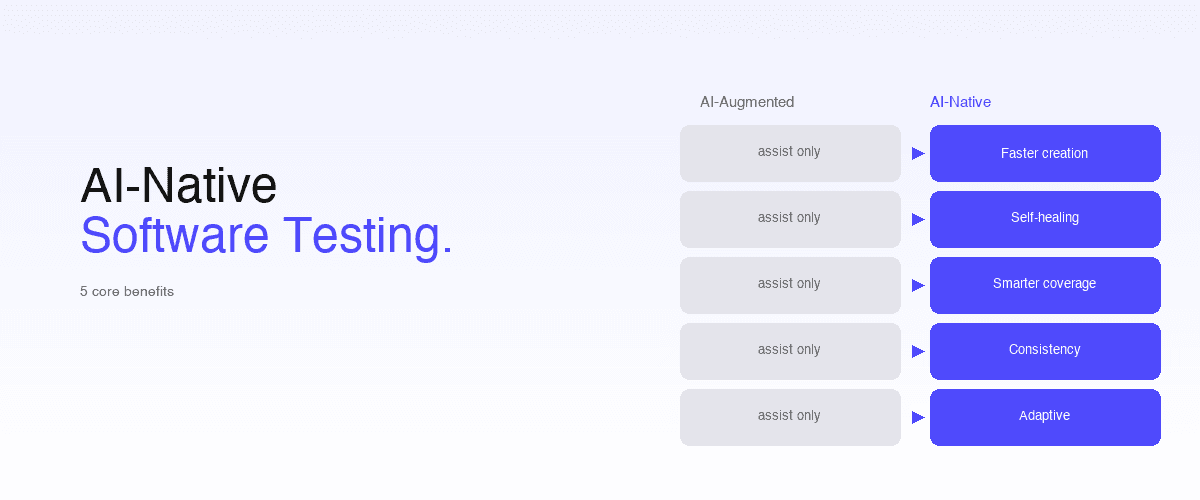
The five core benefits are: (1) much faster test creation and execution, (2) self-healing with lower maintenance overhead, (3) smarter coverage through AI-driven generation and prioritization, (4) improved accuracy and consistency, and (5) continuous, adaptive testing in fast-changing systems.
The shift is from static, script-heavy QA to a more autonomous system where AI continuously designs, runs, and optimizes testing with minimal manual upkeep and faster feedback.
Key takeaways
- AI-native ≠ AI-augmented. AI-native means AI is the primary operator (authors, runs, heals, interprets); AI-augmented means AI assists a fundamentally human-driven, script-based workflow. The distinction determines whether you actually get the benefits below.
- The five benefits compound. Faster creation feeds smarter coverage; self-healing protects that coverage; consistency makes the signal trustworthy; adaptivity keeps it all current as the app evolves.
- The headline outcome is shorter feedback loops with less manual upkeep: ship faster with fewer regressions, without a proportional QA-headcount increase.
- It's the operating model the AI coding era requires. When AI coding agents generate code faster than humans can write tests, only AI-native testing keeps coverage in step.
What is AI-native software testing?
AI-native software testing is testing where AI is the primary operator across the test lifecycle: generating test cases from user stories, code changes, or natural-language intent; executing them; interpreting results; and healing broken tests when the application changes. Humans set policy and review outcomes rather than hand-authoring and hand-maintaining every test.
This is fundamentally different from traditional automation with AI features bolted on. The distinction is structural, not marketing. See the comparison below and the AI-native testing glossary definition. For the broader umbrella that includes both, see what is AI testing.
AI-native vs AI-augmented testing
| Dimension | AI-Augmented Testing | AI-Native Software Testing |
|---|---|---|
| Who authors tests | Humans write scripts; AI assists | AI generates from intent/specs; humans review |
| Maintenance | Humans fix broken scripts; AI suggests | AI self-heals; humans approve patch diffs |
| Execution | Human-triggered scripted runs | AI-orchestrated, parallelized, context-selected |
| Failure interpretation | Humans triage every failure | AI clusters and attributes; humans confirm |
| Coverage growth | Bounded by human authoring speed | Tracks code-change / agent speed |
| Core unit | Selector-bound code | Natural-language intent |
| Representative tool | A code framework with an AI plugin | Shiplight: intent YAML in your repo, authored by your coding agent |
If AI only suggests selectors or flags flakes inside an otherwise human-driven Selenium/Cypress workflow, that's AI-augmented: useful, but it does not get you the benefits below. AI-native is required to actually get them. See self-healing vs manual maintenance.
The 5 core benefits of AI-native software testing
1. Much faster test creation and execution
AI-native systems generate test cases from user stories, code changes, or natural-language descriptions, then run large suites in parallel. This collapses the slowest part of QA (authoring) and shortens feedback loops dramatically. Teams ship faster with fewer regressions because coverage arrives with the feature instead of a sprint later.
See AI testing tools that automatically generate test cases and boost test coverage with agentic AI.
2. Self-healing and lower maintenance overhead
In traditional automation, every UI or API change breaks selector-bound scripts and triggers manual updates: historically 40–60% of QA engineering hours. AI-native tools detect the change and automatically re-resolve the locator or test logic (proposing a reviewable patch rather than silently rewriting), cutting ongoing maintenance toward zero. See near-zero maintenance E2E testing and intent, cache, heal pattern.
3. Smarter coverage through AI-driven generation and prioritization
Instead of relying only on manually designed suites, AI identifies high-risk areas, generates edge-case scenarios humans wouldn't think to script, and prioritizes tests by historical failure patterns and recent code changes. This improves defect detection while avoiding unnecessary test execution: coverage gets both broader and more focused. See requirements to E2E coverage and the agentic QA benchmark.
4. Improved accuracy and consistency
AI-native execution reduces human error in repetitive runs and ensures tests execute identically across environments. That produces more reliable, reproducible results, especially valuable in large CI/CD pipelines where flaky, environment-dependent runs erode trust in the signal. See from flaky tests to actionable signal.
5. Continuous, adaptive testing in fast-changing systems
Because AI-native tools learn from ongoing test runs and code evolution, they adapt as the application changes, making them especially suited to modern DevOps and rapid-release environments where the app is a moving target. Coverage stays current instead of decaying between maintenance sprints. See coverage decay and AI-native test strategy in 2026.
Why AI-native testing matters in the AI coding era
The benefits aren't abstract: they're a response to a structural change. AI coding agents (Claude Code, Cursor, Codex, Copilot) now generate code faster than any human-authored test suite can keep up with.
AI-augmented testing still bottlenecks on human authoring and maintenance; only AI-native testing scales with agent-speed development, because the AI authors and heals the tests too. See the human QA bottleneck in agent-first teams and agent-native autonomous QA.
The authoring side of that change has its own name. When the agent builds from a written specification rather than a chat prompt, tests can be generated from the same document the code was generated from: spec-driven development with AI coding agents covers the loop, and spec-driven development vs TDD covers how it relates to the practice it most resembles.
Short definitions of both terms: spec-driven development and continuous verification. The security-specific version of what goes wrong is in AI code security.
How to adopt AI-native software testing
You don't need a rewrite; adopt incrementally:
- Week 1: Author new tests as natural-language intent (Shiplight YAML) instead of selector-bound code. Existing scripts keep running.
- Week 2: Turn on self-healing as the default for the new intent suite; measure the maintenance-hour delta.
- Week 3: Wire PR-time CI gates so coverage gates merges, not nightly batches. See E2E testing in GitHub Actions.
- Week 4: Connect your AI coding agent via MCP so it generates and runs tests in-session. See the 30-day agentic E2E playbook.
Conclusion: from script-heavy QA to an autonomous testing system
AI-native software testing is the shift from static, script-heavy QA to a system where AI continuously designs, runs, and optimizes testing with minimal manual upkeep and faster feedback. The five benefits (faster creation, self-healing, smarter coverage, consistency, and continuous adaptivity) compound into the headline outcome: ship faster with fewer regressions, without scaling QA headcount proportionally.
The dividing line is whether AI is the primary operator (AI-native) or just a helper on a human-driven workflow (AI-augmented); only the former delivers the benefits.
Shiplight AI is AI-native by construction: tests authored as natural-language YAML in your git repo, self-healing by default via the AI Fixer, and MCP so your coding agent generates and runs tests in the same session it writes code. Book a 30-minute walkthrough and we'll map your current QA against the five AI-native benefits.
Frequently Asked Questions
What is AI-native software testing?
AI-native software testing is testing built around AI from the ground up: AI generates, maintains, executes, and interprets tests as part of the development lifecycle, with humans setting policy and reviewing outcomes. It is distinct from traditional automation with AI features added on (AI-augmented testing), where AI only assists a fundamentally human-driven, script-based workflow.
What is the difference between AI-native and AI-augmented testing?
AI-augmented testing adds AI features like smart locators and healing suggestions to a human-authored, selector-bound suite: the human still drives. AI-native testing makes AI the primary operator that authors, executes, heals, and clusters failures, while humans review and set policy. The five benefits only materialize in the AI-native model; AI-augmented just reduces friction on the human-authoring bottleneck.
What are the benefits of AI-native software testing?
Five core benefits: faster test creation and execution (tests generated from intent and run in parallel), self-healing with lower maintenance, smarter coverage (AI generates edge cases and prioritizes by risk), accuracy and consistency from repeatable execution, and continuous adaptive testing as the app evolves. Together they shift QA from script-heavy to autonomous with minimal manual upkeep.
Does AI-native testing replace QA engineers?
No. AI-native testing replaces the mechanical work (script authoring, selector maintenance, repetitive execution, first-pass triage). QA engineers move to higher-value work: setting quality policy, reviewing AI-generated tests, exploratory testing, and business-logic judgment. Teams typically report stable QA headcount with substantially more coverage. See the QA role in the AI era.
How does AI-native testing improve test coverage?
It removes the two ceilings traditional automation hits: authoring speed (AI generates tests as fast as code changes) and maintenance debt (self-healing stops the suite from decaying).
It also generates edge-case scenarios and prioritizes by historical failure patterns, so coverage becomes both broader and more risk-focused rather than just "whatever someone had time to script." See boost test coverage with agentic AI.
Is AI-native software testing production-ready in 2026?
Yes for the core capabilities: AI test generation, self-healing, intent-based execution, and agent-native verification are in production at teams from AI-native startups to enterprises. The reliable pattern is "AI authors and heals, humans review intent before merge"; fully autonomous test acceptance without any review is still emerging. See what is agentic QA testing.
What tools provide AI-native software testing?
Shiplight AI is built AI-native: intent-based YAML in your git repo, MCP-callable by coding agents, heals surfaced as reviewable PR diffs. Other platforms sit in a different design center, such as vendor cloud consoles hosting constrained plain-English tests.
The real test: does the AI author and maintain tests, or only assist a human who does? See best AI testing tools in 2026.