AI in software testing means using artificial intelligence (large language models, machine learning, computer vision, and agentic systems) to generate, execute, maintain, and interpret software tests across the development lifecycle, rather than relying only on hand-written scripts and manual execution.
By 2026 it has moved from an experimental add-on to the default operating layer of modern QA: AI authors tests from intent, heals them when the UI changes, prioritizes them by risk, and clusters failures for triage.
This guide covers the role of AI across the test lifecycle, the methods in use, the measurable benefits, the honest pros and cons, the 2026 tool landscape, and where the practice is heading.
Key takeaways
- AI in software testing is a lifecycle change, not a single feature. It touches planning, authoring, execution, maintenance, and failure analysis: each with its own AI technique.
- The headline outcomes are speed and lower maintenance: tests generated from intent in minutes, self-healing across UI change, and triage that clusters failures instead of investigating each one.
- It is not magic. Hallucinated tests, opaque failure modes, data-residency concerns, and false confidence are real constraints that a disciplined process must manage.
- "AI in software testing" is the broad practice; "AI testing" categories and "AI-native testing" are how you implement it. See what is AI testing for the taxonomy and AI-native software testing for the built-from-the-ground-up model.
What is AI in software testing?
AI in software testing is the application of artificial-intelligence techniques to automate work in the QA lifecycle that was previously manual: deciding what to test, writing the tests, running them, maintaining them as the application changes, and interpreting the results.
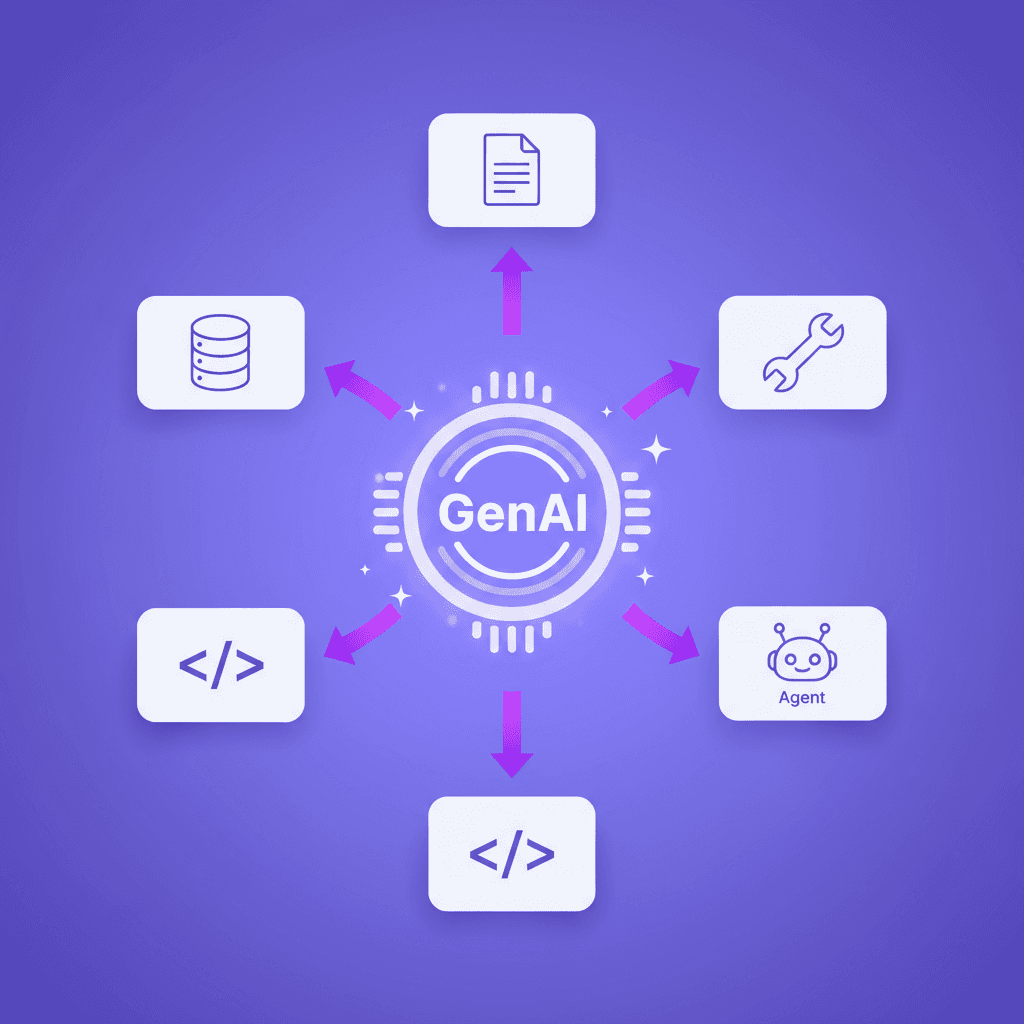
The "AI" is broader than one model class: LLMs for generation from intent, computer vision for element resolution, machine learning for flakiness detection and risk prioritization, and agentic systems that combine all of it into a planning–acting–learning loop.
For the formal category map (the five sub-categories: test generation, self-healing, agentic QA, AI-augmented automation, no-code), see what is AI testing. For the generative-AI-specific subset, see generative AI in software testing.
The role of AI across the software testing lifecycle
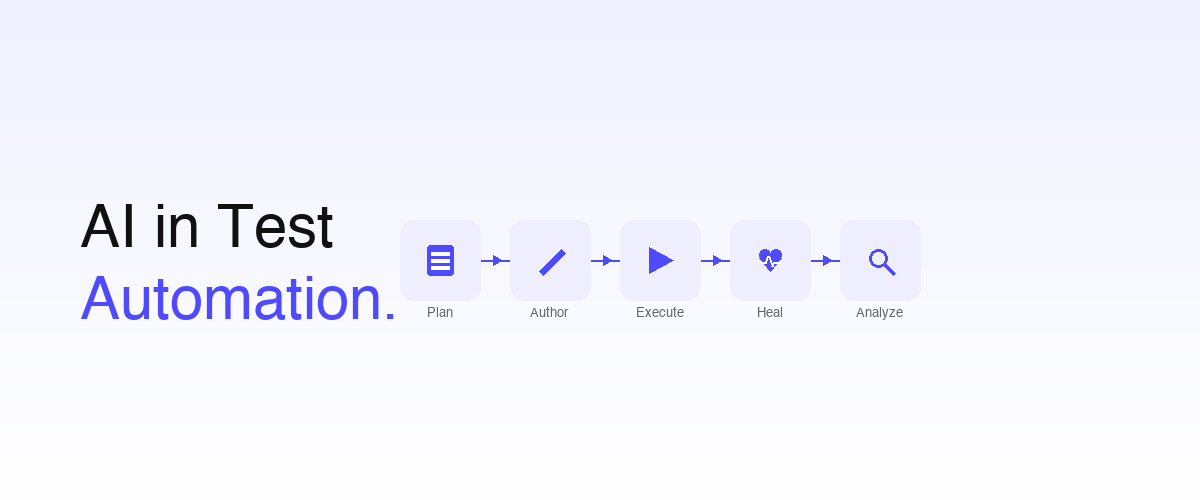
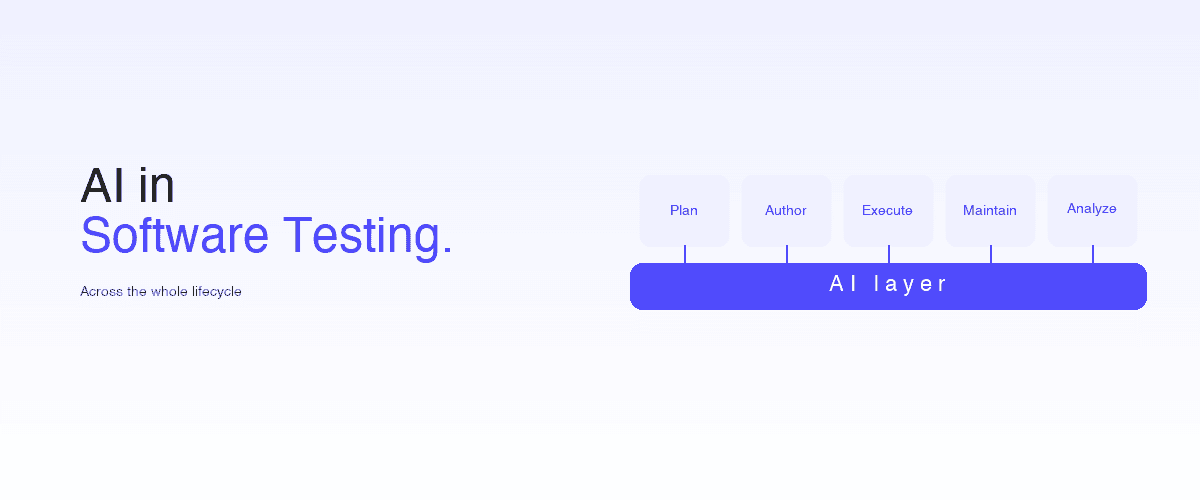
AI plugs into five distinct stages. This is the practical answer to "what does AI actually do in testing":
- Plan: generate candidate test scenarios from user stories and code changes; prioritize by historical failure patterns and risk.
- Author: convert natural-language intent into executable tests, removing the slowest part of QA. See AI testing tools that automatically generate test cases.
- Execute: resolve UI elements by intent/vision rather than brittle selectors; run suites in parallel with smart waits.
- Maintain (self-heal): detect UI/API changes and re-resolve tests automatically, proposing reviewable patches instead of breaking. See self-healing vs manual maintenance.
- Analyze: cluster failures into root-cause groups, distinguish flakes from real defects, generate likely-cause hints.
For the deeper per-stage breakdown, see AI in test automation.
Methods of AI in software testing
- Intent-based / NLP authoring: describe the test in natural language; the system generates and resolves it. See intent-based testing.
- Computer-vision element resolution: identify UI elements by appearance and role, surviving DOM changes.
- Machine-learning prioritization: run the highest-risk subset first based on change analysis and failure history.
- Generative test creation: LLMs produce test cases and data from specs. See what is AI test generation.
- Agentic orchestration: an AI agent owns the full loop (plan → generate → execute → heal → learn). See what is agentic QA testing.
Benefits of AI in software testing
- Faster test creation and execution: coverage arrives with the feature instead of a sprint later; suites run in parallel.
- Lower maintenance overhead: self-healing cuts the 40–60% of QA hours historically lost to fixing selector-bound scripts.
- Smarter, risk-weighted coverage: AI generates edge cases and prioritizes by risk, improving defect detection while avoiding wasted execution.
- Accuracy and consistency: repeatable, environment-stable execution makes CI/CD signal trustworthy.
- Continuous, adaptive testing: the system adapts as the application evolves, fitting rapid-release DevOps.
These map directly to the five core benefits of the AI-native software testing model and the coverage math in boost test coverage with agentic AI.
Honest pros and cons
A balanced view (the part marketing pages skip):
Pros
- Removes the authoring and maintenance bottlenecks that cap traditional automation.
- Scales coverage with code-change speed instead of human typing speed.
- Frees QA engineers for exploratory testing and judgment work.
Cons / constraints
- Hallucinated tests: LLMs can generate tests for behavior that doesn't exist or with wrong expected values. Mandatory human review in PR.
- Opaque failure modes: when AI healing or analysis is wrong, the reasoning isn't always inspectable. Require structured patch diffs, not silent rewrites.
- Data residency: sending DOM/app state to LLM providers raises compliance questions; pick SOC 2-certified tools.
- False confidence: teams can drift into rubber-stamping AI output. Keep humans on intent review and quarterly audits.
For the strategy that manages these constraints, see how to build a testing strategy for AI-generated code.
AI software testing vs manual testing
AI doesn't eliminate manual testing; it reallocates it. AI handles the repeatable, high-frequency layer (regression, smoke, cross-browser); humans keep exploratory testing, UX judgment, and regulated-domain decisions, where machines are weakest. Most teams report stable QA headcount with far more coverage. See the QA role in the AI era and how to reduce manual testing effort.
The 2026 AI software testing tool landscape
| Category | Representative tools / operating model |
|---|---|
| Agent-native, intent-based (tests in your repo) | Shiplight AI |
| Vendor cloud consoles (low-code / constrained plain-English) | Tests live in the vendor's console and run on its hosted runners |
| Spec-driven generation services | Tests generated from specs; execution runs in the vendor's cloud |
| Managed QA services | The vendor's QA engineers write and own your suite |
| Unit-test generation | Diffblue, Qodo |
| Code-based (no AI) baseline | Playwright, Cypress, Selenium |
See best AI testing tools in 2026, best AI automation tools for software testing, and coding-agent plugins for automated test generation for full comparisons.
The future of AI in software testing
The trajectory through 2026 and beyond: from AI-assisted (AI helps a human-driven workflow) to AI-native (AI is the primary operator) to agent-native (the AI coding agent that writes the feature also writes and runs its test in the same session, via MCP).
Coverage stops tracking human authoring speed and starts tracking code-generation speed. See agent-native autonomous QA and AI-native test strategy in 2026.
Conclusion
AI in software testing has crossed from experiment to default operating layer. The practice spans the full lifecycle (plan, author, execute, maintain, analyze) and delivers faster feedback with far less manual upkeep, provided the real constraints (hallucination, opacity, data residency, false confidence) are managed with disciplined human review.
The dividing line between marginal gains and transformation is whether AI is bolted onto a script workflow or built in as the primary operator.
Shiplight AI implements AI in software testing the AI-native way: natural-language YAML tests committed in your git repo, self-healing by default, and MCP so your coding agent generates and runs tests in the same session it writes code. Book a 30-minute walkthrough and we'll map your QA lifecycle to where AI delivers the most.
Frequently Asked Questions
What is AI in software testing?
AI in software testing is the use of artificial intelligence (LLMs, machine learning, computer vision, agentic systems) to automate QA work that was previously manual: planning, authoring, executing, maintaining, and interpreting tests. It spans five stages (plan, author, execute, maintain, analyze) and ranges from AI-assisted features on a script suite to fully AI-native systems where AI is the primary operator.
What is the role of AI in software testing?
AI plays five roles across the lifecycle: planning (generating and prioritizing scenarios by risk), authoring (turning intent into executable tests), execution (resolving elements by intent/vision, running in parallel), maintenance (self-healing when the UI changes), and analysis (clustering failures and generating root-cause hints). The net effect is shorter feedback loops with less manual upkeep.
What are the benefits of AI in software testing?
Faster test creation and execution, lower maintenance overhead (self-healing eliminates most of the 40–60% of QA hours lost to selector fixes), smarter risk-weighted coverage, accuracy and consistency in CI/CD, and continuous adaptive testing as the app evolves. The benefits compound: faster creation feeds smarter coverage, self-healing protects it, consistency makes the signal trustworthy.
What are the cons or limitations of AI in software testing?
Four real constraints: hallucinated tests (AI can assert behavior that doesn't exist; require human review), opaque failure modes (AI reasoning isn't always inspectable; require structured patch diffs not silent rewrites), data residency (DOM/state sent to LLM providers; pick SOC 2-certified tools), and false confidence (teams rubber-stamping AI output; keep humans on intent review and quarterly audits).
Is AI replacing manual testing?
No, it reallocates it. AI handles the repeatable high-frequency layer (regression, smoke, cross-browser); humans keep exploratory testing, UX judgment, and regulated-domain decisions. Most teams report stable QA headcount with substantially more coverage, with QA engineers shifting to higher-value work. See the QA role in the AI era.
How do I start using AI in software testing?
Incrementally: author new tests as natural-language intent instead of selector-bound code; enable self-healing as the default on that suite; wire PR-time CI gates; then connect your AI coding agent so it generates and runs tests in-session. Existing scripts keep running throughout; no rewrite required on day one. See the 30-day agentic E2E playbook.
What is the difference between "AI in software testing" and "AI-native testing"?
"AI in software testing" is the broad practice: any use of AI across the QA lifecycle, including AI-assisted features on a traditional script suite. "AI-native testing" is the narrower model where AI is the primary operator from the ground up, not added onto a human-driven workflow. See AI-native software testing.